Unknown's avatar

About David Wood

Chair of London Futurists. Principal of Delta Wisdom

The Zeitgeist of Change

By Stuart Mason Dambrot, Synthesist | Futurist, Critical Thought

When envisioning, planning for or attempting to create a future scenario, an often-overlooked problem is ignoring the Zeitgeist – the dominant school of thought that typifies and influences the culture of a particular period in time. As a result, such scenarios have an overly narrow focus on that specific scenario alone. As a result, institutionalized aspects of human behavior do not change in isolation, but are nonetheless conceptualized as separate entities.

As a result, the scenario in question – whether, for example, political, technological, economic, or sociocultural – will carry a higher than necessary probability of failure to materialize or, if apparently successful at first, to sustain the structural and functional design originally intended. This then leads to increasing divergence from that initial design, and so requires propaganda – and more often than not, ultimately the application of force – to maintain power.

To understand why this ultimately counterproductive approach to governance characterizes human behavior, it’s necessary to look in a direction rarely addressed in political dialogue: the evolution of H. sapiens neurobiology.

The typically unarticulated factors at the core of this issue follow. While clearly interrelated, these will first be addressed individually before being integrated into a cohesive proposition that presents possible Transhumanism efforts in science and technology that might provide solutions to this pervasive and persistent dilemma. In short, H. sapiens:

  1. unconsciously forms in-groups and out-groups that compete for legitimacy and power
  2. is a social species with (typically) an alpha male-based structural hierarchy
  3. mistakes beliefs and observation-based inductive inference for knowledge and fact-based deductive conclusions, respectively
  4. has a cognitive system based largely on emotion and metaphor
  5. exhibits cognitive bias and often lacks meaningful self-awareness

While this chapter is obviously not an academic treatment, we can nevertheless deconstruct our cognitive and behavioral patterns in the light of these defining characteristics in the interest of transcending our current political systems.

Human Phylogeny

Human Phylogeny. Credit: Stearns & Hoekstra (2005). Reproduced by permission of Oxford University Press. © Oxford University Press [xvi]

The Nature of Human Nature

We can learn a great deal about ourselves by observing chimpanzees and bonobos – our closest living primate relatives. Our DNA differs from that of both species by only 1.2 % (although they differ from each other in both DNA and social behavior [i]). We all share a common non-human ancestor some eight to six million years ago [ii], while chimpanzees and bonobos diverged from each other some 1.5-2 million years ago. As such, it is more enlightening to say that we’re like them than the typical view that they’re like us – and what’s enlightening is the range and specificity of behaviors that we share.

In addition to chimpanzee behaviors observed in the lab that are associated with high intelligence – such as recognizing themselves in a mirror and communicating through a written language – it is their untrained behavior in the wild that is truly revealing. This includes having a dominant alpha male leader; ingesting medicinal plants for a range of ailments; using leaves for bodily hygiene; raiding and decimating other chimpanzee troops to acquire their territory and food resources; and – in perhaps the most telling example – practicing the art of deception: In a troop of male chimpanzees walking in single file though the forest in search of food, a single individual spots a piece of fallen fruit off to one side of the trail. That individual then turns to the opposite side of the trail and looks at the forest floor with an exaggerated stare. Once the other chimpanzees are straining to see what he is apparently looking at (as humans would do), he leaps to the fruit and grabs it for himself.

In other words, deception is a trait we share with chimpanzees that provides a highly functional evolutionary advantage in a hierarchical social species based on alpha-structured resource acquisition and control.

Interestingly, bonobos have a very different culture, being matriarchal and peaceful. For example, while chimpanzees engage in copulation primarily for propagation – with high-ranking males monopolizing and guarding females in estrus – bonobos engage in sex to reduce tension and resolve conflicts, offer a greeting, form social bonds, elicit social or food benefits (young females, in particular, may copulate with a male then take or receive food from him), and other reasons. Unlike chimpanzees, bonobos are female-dominant with an alpha female social hierarchy, and in the wild have not been observed to exhibit lethal aggression.

Since we exhibit qualities of both species, the question becomes one of scale. Specifically, at individual and small scales, we tend towards less aggressive bonobo-like behaviors – but within large-scale societal agglomerations artificially delineated on the basis of an abstract definition (in this discussion, politics, as well as economics, organized religion, nationalism, militarism, and so on), we engage in more chimpanzee-like aggressive behaviors.

Either way, in many ways we are (so to speak) chimps in suits.

This is the heritage we carry forward, even with our uniquely powerful brains. What’s even more astounding, however, is the revelatory finding reported in recently-published research [iii],[iv] that a single genetic mutation appears responsible for the uniquely neuron-dense neocortex we share with two other extinct hominin species, Neanderthals and Denisovans. (That said, since these two species did not create a robust culture as we have, it appears that more neurons are not enough: our cognitive abilities appear to rely on other factors, such as how those neurons are interconnected.) The point is that this unique gene is one out of the some 20,000 genes that comprise our genome [v], most of which share with chimpanzees and bonobos.

In-group Favoritism and Intergroup Aggression

That an us-versus-them mentality drives our social behavior [vi],[vii] is obvious – sometimes tragically – in politics, religion, nationalism, sports, multiplayer video games, and other large interest- and/or belief-based agglomerations. What is not fully realized is how little it takes for even a small number of strangers to quickly bond on the basis of almost anything – even eye color [viii], a random grouping, or a grouping based on an otherwise meaningless object or task.

In one such experiment [ix], investigators studied collaborations of 10-person groups in which some members were collocated and others were isolated. Individuals bought and sold shapes from each other in order to form strings of shapes, where strings represent joint projects, and each individual’s shapes represented his or her unique skills. The investigators found that the collocated members formed an in-group, excluding the isolates – but the isolates also formed an in-group.

In short, based on little or no substance we automatically form in-groups that are biased against and aggressive towards corresponding out-groups – without being aware of doing so. This characteristic alone is responsible for much of our discord, violence and dysfunctional governance.

Tools, Language and Logic

While other animals make and use tools – such as chimpanzees fashioning, along with other tools, “termite fishing toolkits” from twigs and branches [x] – we alone have created tools, structures and technologies that have dramatically transformed, and will increasingly transform, ourselves and our planet and exoplanetary environments. At the same time, our spoken and then written ability to communicate with other members of our species graduated from signs to symbols, leading to an incredibly rich language fueled by our ability to generalize and categorize the patterns we detect through our senses. The final component of this intellective triptych is the emergence of reason (using existing knowledge to draw conclusions, make predictions, or construct explanations) and its formal representation, logic.

While there are far too many reasoning methods and logic systems to cover here, the three that matter most in this discussion are deduction, induction and abduction[xi]. Deductive reasoning is a logical process which derives a definite conclusion as a logical consequence of premises that are assumed to be true. On the other hand, inductive reasoning infers probabilistic generalizations from specific observations, where the conclusion can be false even if all of the premises are true. Finally, abductive reasoning reverses the direction of inference, inferring a probable premise, cause or explanation for an observed consequence.

In this discussion, we’re primarily concerned with deduction and induction. (Abduction comes into play where, for example, we envision a future state – political or otherwise – and “reverse engineer” the conditions that would likely lead to that state – an approach well-suited to transpolitics, if only we could have universal agreement on that future state should be.)

In the case of deduction and induction, there are three critical issues that often go overlooked in daily discourse (“a watched kettle never boils”), but oftentimes – as a reminder of a chimpanzee deceiving others in his group in the pursuit of self-interest – are intentionally leveraged in rhetorical speech, political dialogue and propaganda: (1) depending on the truth of the original premises, a deductive conclusion can be true or false even if logically valid; (2) a deductive conclusion can be valid even if the premise is false; and (3) an inductive inference is erroneously thought to be or presented as a deductive conclusion.

As such, a central goal of a future transpolitical environment is educating, encouraging and supporting the abandonment of generating misleading communications by intentionally or unintentionally manipulating logic.

The Invisible Hand of Emotion: Rationality as an Afterthought

Rationality is the quality or state of being reasonable, based on facts or reason. Rationality implies the conformity of one’s beliefs with one’s reasons to believe, or of one’s actions with one’s reasons for action. However, it’s not that simple: What is considered rational is relative, in that the operational cognitive model – reflected in often unspoken framing – determines whether or not a decision is rational or not – for example, whether the model primarily values the individual or the group.

Moreover, unlike our advanced neocortical cognitive capabilities, emotions arise in a much more primitive part of our brain – the limbic system. Nevertheless, emotions influence and interact with cognition in a number of important ways. Perhaps more importantly, emotion is causative in decision-making by unobtrusively engaging prior to cognitive activity, reasoning and rational thought. A case in point: Scientists presented subjects with what is known as a visual choice reaction task, in which a button had to be pressed when an image was presented. Using functional magnetic resonance imaging (fMRI) to image the brain areas active during this task, the researchers observed activity not in the part of the neocortex where rational decisions are made, but rather in a deeper brain area called the anterior cingulate cortex, which is associated with error detection, motor activity, conscious experience and, in this experiment, possibly, acting as an interface between limbic and cortical systems [xii].

Another factor that can be used in rhetorical or persuasive communications to facilitates a speaker’s ability to control the emotional component of cognition, memory and language is that we describe and understand the world primarily through metaphor [xiii] – a word or phrase used to compare two unlike objects, ideas, thoughts or feelings to provide a clearer description of one using the other.

Relatedly, a process known as framing – how individuals, groups, and societies organize, perceive, and communicate about reality – is used by mass media sources, political or social movements, political leaders, or other actors and organizations to make false or exaggerated comparisons that can be persuasive when a logical argument would not be.

Know Thyself

A field of inquiry since antiquity in both Eastern and Western philosophy, self-awareness (also referred to as self-knowledge, mindfulness, metacognition [xiv], and other terms) is the practice of intentional, non-judgmental introspection of our patterns of thinking, feeling, and acting. The goal is to develop the ability to go beyond mere consciousness of one’s body and environment to gain a deeper understanding of one’s assumptions, biases, predilections, biases, motives, values, emotions, thoughts, metaphors, and other typically unarticulated contributors to and causes of otherwise unexamined habits of cognition and behavior. Self-awareness is achieved through a variety of channels, including meditation, counseling, psychotherapy, education, and training.

The need for this new perspective is obvious. Our history – past, present and (at least in the short-to medium term) future – is marked by an endless series of violent practices in what is often archaically referred to as man’s inhumanity to man. Moreover, these large-scale events, such as invasion, war, genocide, atrocities, religious hatred, violent racism, abusive sexism, induced poverty, and exploitation, have their roots and counterparts in small-scale and individual antisocial – and sometimes seen as idiopathic – behaviors like lying, cheating, stealing, interpersonal abuse and violence, and other unfortunately everyday activities. When we do assign cause, we tend to point to a variety of secondary and tertiary causes of such behaviors. However, everything we do – not only the above, but all of our technology, economics, philosophy, beliefs, creativity, and most assuredly politics – is a primary expression or instantiation of a neural state of which we are seldom aware and therefore rarely articulate or consider as causative or even relevant.

In the specific domain of transpolitical change, the aforementioned issue of scale is central by virtue of the large number of persons involved in relation to the practice of self-awareness being de facto an individual pursuit. Given our near-universal priority being growth, productivity and wealth, a global environment supporting self-awareness appears to be a far-future scenario – an enlightened society that no longer requires laws defining, and enforcement maintaining, restricted and coerced behavior. In this scenario, individual self-awareness is an essential cornerstone of an enlightened transpolitical system in which the strong do not victimize the weak [xv].

The Zeitgeist of Change

Taking these powerful, universal, and often silent factors into question, and the way they influence – and when acted upon unthinkingly, determine – our thoughts, priorities, decisions, communications, and behavior, we can begin to see ourselves in aggregate as an enormously intelligent species that still prioritizes competitive self-interest, and that thinks and acts based more on instinct and impulse than reflection and insight. This clear and present reality is the fundamental causative determinant in the cyclical nature of political dialectic, as well as the generative force in creating the illusion that our social institutions – be they political, national, religious, economic, military, scientific, creative, or any other of the myriad aspects of human behavior – are rationally-created entities that have an existence of their own outside the realm of humans acting in groups of various sizes, values, goals, and resources.

In order to successfully and consistently consider societal evolution as a whole rather than just focusing on alternate political systems, and thereby to maximize the probability of creating non-dystopic futures, we would be best served by adopting what might be considered a medical model. In other words, to stop treating what can be considered the symptoms of human nature – that is, dysfunctional politics and other agglomerative In/Out group-mediated social institutions – we need to:

  1. use that awareness to move beyond our evolutionary impulses to acquire power and control over others
  2. foster a deeper awareness of our emotion- and self-interest-driven motivations
  3. learn through guidance and practice how to decouple those impulses from our political behavior
  4. use this new self-knowledge to model non-exploitative transpolitical systems that are no longer manifestations of evolutionary drives, unexamined beliefs and experience-based neocortical models of perceived value and alpha dominance
  5. use these models to design transpolitical constructs that implement our rational and cooperative traits

References

[i] The Social Behavior of Chimpanzees and Bonobos (http://primate.uchicago.edu/Stanford.pdf)

[ii] Comparing the human and chimpanzee genomes: Searching for needles in a haystack (http://genome.cshlp.org/content/15/12/1746.full)

[iii] Xeroxed gene may have paved the way for large human brain (http://news.sciencemag.org/biology/2015/02/xeroxed-gene-may-have-paved-way-large-human-brain?intcmp=highwire)

[iv] Human-specific gene ARHGAP11B promotes basal progenitor amplification and neocortex expansion (http://www.sciencemag.org/content/early/2015/02/25/science.aaa1975)

[v] The shrinking human protein coding complement: are there now fewer than 20,000 genes? (http://arxiv.org/abs/1312.7111)

[vi] Evolution of in-group favoritism (www.nature.com/srep/2012/120621/srep00460/full/srep00460.html)

[vii] Intergroup Bias (http://www.psych.purdue.edu/~willia55/392F-%2706/HewstoneRubinWillis.pdf)

[viii] In-groups, out-groups, and the psychology of crowds (https://www.psychologytoday.com/blog/fulfillment-any-age/201012/in-groups-out-groups-and-the-psychology-crowds)

[ix] In-group/Out-group Effects in Distributed Teams: An Experimental Simulation (http://www.ics.uci.edu/~jsolson/publications/DistributedCollaboratories/Bos_IngroupOutgroup.pdf)

[x] Chimps Shown Using Not Just a Tool but a “Tool Kit” (http://news.nationalgeographic.com/news/2004/10/1006_041006_chimps.html)

[xi] Deductive Reasoning vs. Inductive Reasoning (http://www.livescience.com/21569-deduction-vs-induction.html)

[xii] Volition to Action—An Event-Related fMRI Study (http://www-psych.stanford.edu/~span/Publications/gw02ni.pdf)

[xiii] The Metaphorical Structure of the Human Conceptual System (http://www.fflch.usp.br/df/opessoa/Lakoff-Johnson-Metaphorical-Structure.pdf)

[xiv] Metacognition and cognitive monitoring: A new area of cognitive–developmental inquiry (http://psycnet.apa.org/journals/amp/34/10/906/)

[xv] Dialogues with the Dalai Lama (http://www.mindandlife.org/dialogues-dalai-lama/)

[xvi] EVOLUTION: AN INTRODUCTION (2nd Edition) by Stephen Stearns & Rolf Hoekstra (2005) Figure 19.1 from p. 481. Figure may be viewed and downloaded for personal scholarly, research and educational use. To reuse the figure in any way permission must first be obtained from Oxford University Press. Figure is not under a Creative Commons license.

Footnote

The article above features as Chapter 8 of the Transpolitica book “Anticipating tomorrow’s politics”. Transpolitica welcomes feedback. Your comments will help to shape the evolution of Transpolitica communications.
Democratic Intelligence

By Stephen Oberauer, senior software developer, London

DI3

My experience of politics

I was born in South Africa in 1978, and remained ignorant about apartheid until I was about eleven years old.  I knew that different races lived in different areas and went to different schools, and that black people were generally poorer and less educated than white people, but I had no idea that there was an unnatural law, enforcing the division.

South Africa has been described as the “protest capital of the world,” with thousands of protests every year.  I had often see footage of violent protests on television, but remained safe in my parents’ suburban home, twelve miles from the center of Cape Town.  Nelson Mandela was released from prison in 1990, signalling that change and democracy was on its way, but this did not seem to reduce the number of protests or amount of political violence.  In 1993, four men with grenades and assault rifles shot up the nearby St. James Church, killing 11 people and wounding 58, including some people that I knew.  My neighbour had shrapnel wounds.  A man I later worked with lost both his legs and an arm, and the woman who later became my mother-in-law, was shot in the arm while protecting her face.  The murderers claimed that they were following their orders and that they regarded all whites as legitimate targets as they were complicit in the government’s policy of apartheid.

In 1994, we had our first democratic elections, for which I was too young to vote.  My personal perspective of the major South African political parties was that they were usually quite easily categorized as either white or black, and ranged from extremely racist, admitting to wanting to kill people of the opposite colour, to not obviously racist.  Deciding who to vote for was incredibly simple: Racists voted for racist parties, and those who did not consider themselves to be racist, voted for the party that was the same colour as themselves, with the primary concern to get people out of power that wanted to kill them for the colour of their skin.  Had it been legal for sixteen year olds to vote, I would have voted against Nelson Mandela, partially because I, and most other white people, had no idea what a great leader he’d turn out to be.

Democracy didn’t, however, solve the problems.  I remember having to fetch my wife from work because an angry mob of striking security guards were marching in town, smashing cars and shop windows and heading straight for the shop where my wife was working.  We drove away from the centre of the city in a slow traffic jam, with thousands of other fearful workers, including the slowest Ferrari driver I’ve ever seen, eager to get to the safety our homes.

Today, after 21 years of democracy in South Africa, the murder rate has come down, but there are still about 50 murders a day, with some of the worst rape and hijacking statistics in the world.  There are regular power cuts, the government appears to be in chaos and the number of protests appears to be on the increase.  The current president, Jacob Zuma, has been accused of hate speech, for singing the song, “Kill the Boer.”  Boer is the Afrikaans word for farmer, but the meaning “white person” is implied.  He has also been to court to face charges of rape and corruption.  It seems that democracy, although the most sought after type of government today, is not the solution that South Africa hoped it would be.

Globally

According to The Economist Intelligence Unit (PDF) the countries of the world are governed as follows:

  • Full democracies: 15% of countries, 11.3% of the world population
  • Flawed democracies: 32.3% and 37.2% respectively
  • Hybrid regimes: 22.2% and 14.4%
  • Authoritarian regimes: 30.5% and 37.1%

One might think that the solution to world conflict is to get that 15% up to 100%. But while democracy sounds like a great idea, and generally is much better than a dictatorship, its usual implementations have many flaws.  Having the ability to stand in a queue for an hour or two and select one of the given choices every five years, knowing that one’s single vote in a sea of millions probably won’t make any difference at all, isn’t very much of a choice.

A modern computer system, called LiquidFeedback, has been used by the Five Star Movement in Italy to get instant feedback from whoever wishes to share their opinion or vote on a policy.  Such software makes the thought of standing in a queue every five years seem archaic.  While not everyone has access to the internet, it is a technology that is growing exponentially, and, according to the chairman of Google, everyone on the planet could have internet access within the next five years.  This might be hard to comprehend, especially if you’re not familiar with exponentially growing technology.  If so, it can be useful to think back to what the world was like about ten or twenty years ago.  For me, my internet access was 2,000 times slower just seven years ago.  Internet access is certainly growing quickly, and even if five years is an exaggeration, a large proportion of the world should have internet access soon.

Democracy applies within an entire country.  An even better system, however, would be able to affect decisions made in other countries.  If you lived in Palestine or Israel, and you wanted the other country not to fire rockets at you, how great would it be if your political system allowed you to say so?  And it wouldn’t just be to protect yourself and your family.  The ability to vote against human rights violations in foreign countries would be amazing.  People trapped in a dictatorship could still contribute their intelligence to other countries, and very importantly, the world would not have to suffer just because a few countries are generating ten times more greenhouse gasses than others.  In today’s connected world, where a company can easily exist in one country and have employees scattered around the world, geographical boundaries are losing their meaning.  Perhaps there are more important things to consider than geographical boundaries and age to determine whether or not someone should be allowed to vote, or how important their vote should be, like how much knowledge they have about what they’re voting for, how intelligent they are, or how prejudiced or objective they are.

Consider the quality of information in everyone’s heads. We know that some people are pro capitalism, some are pro socialism, some are extremely concerned about environmental issues, and others believe that global warming is a hoax.  It’s incorrect to assume that the majority of voters know better than the minority, but democracy appears to completely ignore this problem.  I think a good way to illustrate the problem is by talking about the one thing that everyone disagrees on more than politics: religion.

According to PewResearchCenter, the world’s largest major religious group, Christianity, consists of only 31.5% of the world’s population.  Democratically, would this mean that Christianity is the right religion?  Of course not, because no such rule exists.  In fact, if such a rule existed, then we could say that the other 68.5% are right, however the other 68.5% believe completely different things to each other, with Islam having the largest proportion at 23.2%.   Christianity itself is divided up as half Catholic, and half other denominations, with Catholicism itself being divided into many different denominations.  Of the religious people in the world I’d be surprised if many of them, when asked whether they believed their religion was the right one, would say “no.”

Besides politics and religion, opinions differ enormously on topics such as spiritual mediumship, UFOs and aliens, medicine and other forms of healing.  Since everyone believes different things, one has to consider how to get the most accurate and useful information.  For this purpose thinkers have come up with the concepts of critical thinking and the scientific method.  Many books have been written about critical thinking, teaching people to understand common logic errors, cognitive biases, evidence and statistics.  The scientific method is also part of critical thinking and gives us a structured approach to learning, based on evidence, testing and peer reviews.  Learning and applying critical thinking skills vastly improves the quality of information in people’s minds.

I’ve voted in about three of South Africa’s elections.  There have always been many political parties with their leaders’ faces on the ballot paper, most of whom I’ve never heard of before.  They could be geniuses, the likes of which the world has never seen, the next Nelson Mandela, Ghandi, or Einstein.  Unfortunately the vast majority of voters have no idea who these people are.  They will simply vote for the one or two parties that they’ve heard of, and for whatever reason, feel more seduced by.  Perhaps they even vote for the party that has told the most lies.

Another problem with democracy is that money is used to purchase votes, and I’m not talking about corruption.  According to the UK’s electoral commission (PDF), £31.5 million was spent on election campaigning in 2010.  That’s not only highly inefficient, but spending that kind of money to persuade people to vote for a particular political party makes the whole democratic process seem somewhat pointless, as if it’s merely a way to make us feel like we are free.

Even in America, a country whose leaders have told the inhabitants that they have been free for many years, getting electors to repeat lines like “liberty and justice for all,” managed to get 50 million people to vote for George Bush in 2000 – a man who was wrong in his claims [i] that Saddam Hussein had weapons of mass destruction, that Saddam was linked to Al Qaeda, and that Iraqis would be dancing joyfully in the streets to receive American soldiers.  He also grossly underestimated the human and financial costs of the war, and announced, six weeks after the start of the war, that “major combat operations in Iraq have ended.”  The result of the occupation of Iraq, according to sixteen American intelligence agencies was an increase in Islamic radicalism and the risk of terrorism.

But enough about the negative side of democracy.  It was the best thing that we had for a long time, and it has been around for a very long time; traceable back to 600 BC.

To quote R. Buckminster Fuller,

You never change things by fighting the existing reality.

To change something, build a new model that makes the existing model obsolete.

Reasons for conflict

In order to solve the problem of conflict it’s important to understand why it exists in the first place.

In South Africa we were divided into blacks, whites, coloureds and Indians, as well as rich and poor.  The separation caused animosity between the groups.  Without separating people into groups there cannot be a concept of war.  Wars are fought between religions, races and across country borders.  Even civil war is fought between different groups; people who are categorized by their political preference, or their status.  When people are united, and not classified into a group, they will not be able to find a group to fight.  Unfortunately democracy encourages the formation of groups, placing people in boxes such as left wing, right wing, republican and democrat, instead of acknowledging that perhaps we are all members of the same species, each with our good ideas and our faults.

Modern terrorism is a consequence of people having extreme ideas, being brainwashed and unable to be critical of their own thinking.  This is partially due to being part of a group with similar ideas, but also partially because they have not been taught critical thinking.

Poverty also causes conflict.  When people become desperate they act.  Those who are comfortable have no reason to get out and protest.  This is quite obvious in South Africa, where the people who protest are usually poor people who believe they should earn more, or that the government should supply them with a need that is not being met.

Lack of transparency in governments means that governments can get away with doing things that the people don’t know about.  This lack of transparency can lead to corruption, lack of trust, and anarchy.

The last reason for conflict that I want to mention is the lack of a systematic method to change what we care about.  Petitions are often used in an attempt to change the world around us, but unfortunately they often don’t work.  There are usually no requirements for the number of signatures, and often no official person to send the petition to.  They are arbitrary claims that at least a certain number of people want a specific change, but do not mention how many people refused to sign.  They can be generated from misinformation about something that may or may not be true, and stir up feelings of anger, and when they are posted off into the void, they become anyone’s guess as to whether or not something will be done.

I’ve always thought of striking as the most pointless exercise in the world; not working in an attempt to earn more money.  From my experiences in London and France, it feels like strikes are almost regular, as if it’s just a randomly occuring holiday, by people performing important services like transport, education, mining and security.  Transport strikes disrupt millions of parents trying to get home to their children, and holiday makers trying to enjoy what little bit of time they have away from their stressful jobs, and the next month they will strike again, and continue to earn the same, low salary.

When petitions and striking don’t work, people turn to demonstrating, which can turn into riots, and when nothing changes, civil war, simply because people don’t have a systematic method to change what they care about.

I would like to suggest therefore that the kind of government that would be far more effective at making the world a better place and achieving peace would be a…

Self-improving, Transparent, Democratic, Meritocratic, International System.

Let me start by explaining this idea by writing a bit about modern systems, and explaining why they are so effective.

The StackExchange group of websites, with perhaps a hundred sub-sites, each for asking and answering questions about a particular topic, are great examples.  These are similar to many other sites that use a concept called gamification.  Gamification gives the user, or player, a goal, or number of goals, and usually awards the user with points.  In the case of StackExchange, badges and virtual medals are also awarded.

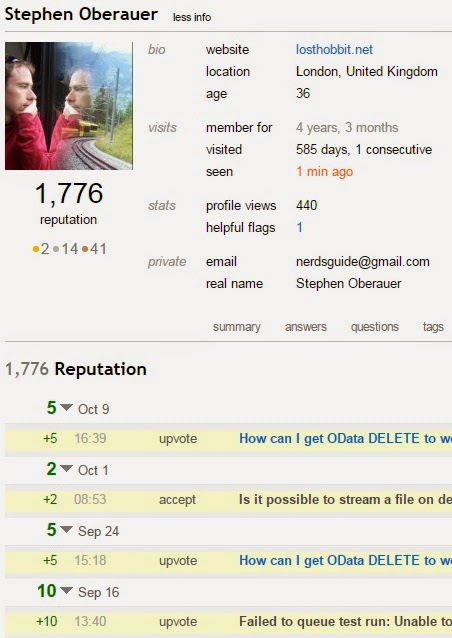
On StackOverflow, their sub-site for asking programming questions, one can ask a programming question, and, if it is a well written question, based on their guidelines, one usually has the correct answer within minutes.  Amazingly, this is a free service.  I’m not quite sure if that explains just how incredible the system is, so let me try another way:  One can either spend hours or days trying to solve a complex programming problem, or type it into StackOverflow and have it answered in minutes!

Stack Overflow Profile

My StackOverflow profile

So, how does the system work?

Everyone can earn points by asking questions, answering questions, doing reviews, improving formatting, etc.  One earns these points democratically, meaning that one earns points by other people looking at what one has done and awarding or deducting points.  Once one reaches a certain number of points, one is considered more trustworthy or knowledgeable and therefore more functions are enabled for that person.  The details are quite complex, but the system has obviously been shaped over many years into what it is today, a beautiful and elegant solution.

Imagine what a self-improving and transparent, democratic, meritocratic system could be like…

It starts with a well defined end goal, perhaps along the lines of “Increase happiness and unity worldwide,” in order to focus the users and help the system to evolve with a purpose.

Ideally the system would be universal, however, realistically it would require the ability to make changes in specific geographical areas where there may be a different need, or more users, or perhaps the system is used by a political party.

Perhaps you, as a user of the system, came up with the idea that it might be good for everyone to get benefits instead of just people who are not working, so you go to the website and type your proposal, “Give benefits to everyone, not just those who are unemployed.”

The website gives you a list of similar suggestions, and noticing that your proposal is already on the system and is number 273 in the queue, with 834 votes, you click the vote button to increase the value of the proposal and write a comment explaining why it would mean so much to you.

proposal

Screen for suggesting a proposal in hypothetical democratic, meritocratic system

The proposal now has 835 votes and with its new value it is bumped up to position 272 in the queue.  Within the next few weeks a further 7,433 people vote for the proposal and it eventually reaches the number one place in the queue.  Your comment on the proposal has been noted by many people and voted up so that it is number five in the list of comments.

People who have earned the most points on the system vote for or against the idea, based on feedback from a group of experts on the subjects involved, including mathematicians and people who are highly clued up about benefits.  The experts each record a ten minute video, or write a short article, explaining anything that they think is relevant, and then the videos and articles are uploaded to the site and linked to the question.  The people with the most points (trusted) watch all the videos and then vote on whether or not to go ahead with the proposal.  Each vote includes the voter’s reason for voting for their choice.

70% of the voters decide that it is not a good idea to give everyone benefits, so the proposal is disapproved, but you are not happy.  You believe that the system is faulty and you should be one of the people with a large number of points, so you can be included in the final round of voting.  For this reason you need to increase your points to 200.  This takes a lot of work.

You answer some critical thinking tests, which bump up your points from 50 to 100.  Then you read all of the recommended books… some history, some logic, some science, some psychology, etc.  One of them doesn’t appeal to you, so you create a proposal that the book is changed.  Eventually you do all the tests on the books that you read and your points are bumped up to 150.  Unfortunately you don’t quite get the points that you need, so you decide to try to become an expert on benefits.

You go to the expert section on the website and follow the strategy to become an expert.  Eventually you write an amazing article on benefits and are selected as an expert.  The next time the benefits proposal makes its way to the top of the list you are ready with your well researched video on how amazing the world would be if everyone had benefits.

Your video is watched by the people with the most points and 80% of them vote for everyone to have benefits and the new policy becomes reality.

Unfortunately the new policy doesn’t work out as well has you’d hoped, but since there is a democratic way to change things, people propose an even better system and the better system is implemented next.

Of course this is a rough idea of a transparent, self-improving, democratic, meritocratic system.  You can probably find faults in this solution.  I can see some already, but this is just the start.  The real system should be thoroughly discussed and thought out and would become more complex as it matures and improves.  The main point, however, of this system, is that it is self-improving and focused.  While existing political systems sometimes have the ability to improve and mature, they are very difficult to change, and can only be improved up to a point, because ultimately their party’s purpose is to stay in power.  They will not hand over the reigns to a system which makes them obsolete.  The purpose of the solution I’m proposing is not for it to remain in power, but for it to improve itself, and recursively replace itself with better systems that also generate solutions.

The system could be used not only for international change, but also for smaller groups, like charities or researchers, trying to figure out the most efficient way to solve a problem.

But imagine if it was used internationally.  Imagine if you could see a clear and well defined path that you could take to suggest any change, or become an expert on any matter so that your knowledge, experience and desire for change could make a difference.

Comparing the idea to existing systems

The White House already has a petitioning system.  This is a great step forward, since it is a formal way to request change, the petition goes to the right people, and the White House have promised to respond.  Unfortunately it still does not make it easy enough to change policies.  For example:

  • It’s up to you to get to 150 signatures in order for your petition to be publicly searchable. It doesn’t matter if you are a genius and spent the last twenty years coming up with your idea. You still need to be able to find 150 people who agree with you, by yourself.
  • You have just 30 days to get 100,000 signatures in order to get a response from the White House. Now that is a lot of signatures.
  • Your petition has limited power. I doubt very much you could petition the president to resign, or ask the government to shut down all the coal power stations and force energy companies to use renewable energy instead, because you believe that long term environmental concerns are more important than short term profit.
  • Lack of transparency. There is no way of knowing who reads the petitions, what their area of expertise is, besides public relations, and whether or not they actually have the power to change anything.

LiquidFeedback is a website used by The Five Star Movement.  It appears to be a very effective tool for holding an instant referendum.  It allows users to vote and select a proxy to vote in their place.  It sounds vaguely similar to the idea that I’m proposing, which I call Democratic Intelligence, so, for clarity, here are the differences:

  • With the default implementation of Democratic Intelligence, the experts, made up of users with the best knowledge of the topic, make the decisions. This, as with all features, could change to a better way of making decisions.  With LiquidFeedback it’s just a referendum, so the decision is still up to the party.
  • LiquidFeedback allows one to select a proxy, meaning that some people will have more voting power than others. In Democratic Intelligence, one does not choose a proxy.  The default implementation is that voting power is based entirely on points based on knowledge; however it could be updated to also include points based on the user’s contributions. Democratic Intelligence is completely systematic, and therefore a user’s popularity shouldn’t make much difference.
  • LiquidFeedback, like Democratic Intelligence, can be used by political parties or other organizations, however one of the main goals of Democratic Intelligence is unity, and therefore to be used globally.
  • Democratic Intelligence is self-improving, whereas in LiquidFeedback, it seems that users only have the ability to make political decisions, not decisions to improve the system.
  • LiquidFeedback does not appear to use gamification.

To summarize, the principles of Democratic Intelligence are:

  • Self-improvement
  • Transparency
  • Democracy, enabling everyone to say what is important to them, and by creating suggestions and ranking the importance of existing suggestions.
  • Meritocracy, in that knowledge is required do do various things like voting and sharing videos and thoughts on suggestions.
  • Unity, wherever possible, with the aim of becoming a global system.
  • Gamification
  • Goal orientation
  • Critical thinking

Practical aspects

How to build it

Building the system is the easy bit.  The system is currently in development, and will be ready to be improved when it is live.  I expect it to go live at democraticintelligence.org around May, 2015.

How to make it grow

The system would require regular use by a large enough group of people in order for its usefulness to be seen and to attract more users and grow.  For this reason it could start as simply a way for a charity similar to GiveWell to decide the most effective way to spend donations.  Perhaps it could be used by activist communities like Zero State and Humanity+ to collaborate internationally.  It could also be used to run a public company, although if the goal of the company is to make money, this could work against peace – seeing as the most effective ways to make money are not necessarily the most moral.

As the system matures, the charity or activist community could, for example, use the system to figure out better ways to find users.  It might decide to accept donations, and it might decide to use some kind of international currency like bitcoins, or it might simply rely on volunteers to complete any tasks that come out of the system.

Imagine an international, virtual community, voting and discussing what to spend money on in an organized fashion in order to achieve their goals.

My dreams are:

  • that the system could expand to become so large and mature, that the best ideas for peace leap out of it like popcorn
  • that petitions, striking, demonstrating, rioting and civil war become obsolete
  • that other, better systems emerge as a result
  • that eventually the entire world is part of a single system that works for everyone

What you can do

If you would like to get involved and help this kind of system become reality, start by joining one of the following groups to follow the progress of the idea, find information to share, discuss ideas that you have about it, and show your support:

Once the website is live, at democraticintelligence.org, you can help out by registering and using the site to share your suggestions, to learn, to vote and to volunteer.  If you know of anyone that would like to use the site, let them know about it.  Share information and videos about it.

Some readers will be skeptical, which is great.  One should not just accept anything that one reads.  If you’re skeptical, I’d love to have your involvement as well.  Visit the groups and share your wisdom so that we can learn from you.  As with any project I get involved in, I like to think of Thomas Edison, the inventor of the light bulb.  Edison invented hundreds of light bulbs that didn’t work before inventing ones that worked well.  His famous quote is “I have not failed. I’ve just found 10,000 ways that won’t work.”  Regardless of how well an idea works, it’s important to keep trying and refining, learning from past mistakes.  I hope we can apply this to politics, continuously trying out new ideas and making old ideas obsolete.

References

[i] From the book, Mistakes Were Made (but not by me), by Carol Tavris & Elliot Aronson, pages 2 & 3

Footnote

The article above features as Chapter 2 of the Transpolitica book “Anticipating tomorrow’s politics”. Transpolitica welcomes feedback. Your comments will help to shape the evolution of Transpolitica communications.
Political Transhumanism and the Transhumanist Party

By M. Amon Twyman, Transhumanist Party Co-Founder, UK Party Leader, Global Party Secretary

Summary

Transhumanism has historically been an effectively apolitical movement, focussed on technological improvement of the human condition. While some political obstacles to that goal have been recognised, Transhumanists’ political views have traditionally covered a broad range, making the emergence of a unified Political Transhumanism seem highly problematic. A paradigm shift appears to have occurred in 2014, with the establishment of the Transhumanist Party in the USA by Zoltan Istvan. Subsequently a number of related groups have rapidly appeared around the world, in an entire new movement dedicated to the idea of Political Transhumanism, with the Transhumanist Party as its primary vehicle in any given country. This chapter will consider the relationship between that movement and Transhumanism as a whole, what character the nascent Transhumanist Party appears to be developing, and the question of possible long-term strategies to transform the politics of the Twenty First Century.

A Unified Political Transhumanism

Transhumanism is an intellectual and cultural movement to expand human capabilities through technology. Transhumanism integrates numerous ideas and ideologies under one umbrella, and that diversity can make it difficult to trace a singular origin to the movement. Although earlier uses of the word “transhuman” and similar concepts have been noted (reaching as far back as Julian Huxley and even Friedrich Nietzsche), the general consensus seems to be that Transhumanism as a modern movement began with the ideas of futurist F.M. Esfandiary (AKA F.M. 2030) at the New School in 1960s New York.

From there, there was a slow emergence of groups in the UK and California which gave rise to the Extropy Institute in the late 1980s, and later an explosive proliferation of organisations and sub-movements owing their growth to the internet. The movement now comprises tens or even hundreds of thousands of members, a number of wealthy patrons, and a wide array of factions and specialist interests. The one consistent idea at the heart of it all, known as the “Central Meme of Transhumanism” or CMT, is that we can and should improve the human condition through technology.

Politically, the movement has historically been highly diverse, with that diversity only increasing with the growth of the movement. Certain popular currents of thought come and go, such as Libertarianism being very popular in Extropian circles in the 1980s and 1990s, but there has never been a point at which being a Transhumanist has strongly implied having a particular political outlook. That diversity has occasionally led to assertions that Transhumanism is inherently apolitical, and in some quarters it is (with Transhumanists often preferring technical over political solutions to problems), but we must note that a diversity of political opinion and a lack of it are not the same thing. There are indeed many Transhumanists with political interests, and although they often differ in those interests they certainly agree on the core impulse of Transhumanism.

The existence of significant (if diverse) political opinion on the part of Transhumanists reflects the fact that many of them recognise that their technological aspirations may be hindered or even blocked entirely by political opponents. There has however never been any serious attempt to unify Transhumanists behind a single political effort, ideology, or framework in order to deal effectively with that opposition. The resultant diversity has historically made the emergence of a unified Political Transhumanism seem highly unlikely. To look at that another way, any unified Political Transhumanism could only represent aspects of the wider Transhumanist movement, and never the entire thing. Such aspects would not just include the occasionally incompatible philosophies which comprise the Transhumanist movement, but also traditional political (e.g. Left/Right) divisions between individual Transhumanists. Any decision as to which aspects of Transhumanism to emphasise could be made deliberately, or allowed to emerge via some process, but in either case there inevitably would be some bona fide Transhumanists who quite rightly felt that the party did not represent their views.

Possible responses to this situation fall into three categories. First, a person could simply say that this is a non-issue, as a political variant of Transhumanism strikes them as irrelevant or undesirable in some way. Although that is a valid point of view, we might note that it is one that politically-empowered opponents of Transhumanism (such as lobbyists on behalf of conservative religious groups) would be very happy to see all Transhumanists adopt.

The second category is the favoured response of fanatical ideologues throughout history: To declare that there is no problem because only one variant of Transhumanism is valid, and all others are not worthy of the name. Putting my own belief in the power of diversity aside, I think it suffices to say that any Political Transhumanism that started out by alienating most Transhumanists would probably not have a high chance of eventual success.

Finally, one might suppose that we could “square the circle”, integrating the various disparate strands of Transhumanism in some manner that preserves difference and yet creates an effective, united front. Any such approach would seem to require that two conditions are satisfied. The first condition is that any approach or ideology consistent with the CMT must be assured a fair chance of at least partially informing policy adopted by Transhumanist political parties, if there is to be any plausible claim to universality by those parties. The second is that when making their decisions, those parties cannot be expected to wait for or please every other person and group calling themselves Transhumanist, since that would lead to deadlock and bland policy which fully satisfies no-one within the movement.

Given these conditions, I would argue that the ancient model we need to follow is not the analytical “squaring the circle”, but the altogether more forthright “cutting the Gordian Knot”. In other words, rather than attempting to carefully balance the concerns and preferences of myriad groups (a nigh-impossible task under even the best circumstances), a Transhumanist political party should boldly move ahead and do as it must. The only caveat – and the one thing stopping this from being the “fanatical” second option already noted – is that all Transhumanists must always have the option of getting involved and shaping policy. No Transhumanist could be excluded from the party on the basis of beliefs that are compatible with the CMT and the existence of the Party itself, no matter how unorthodox they may be.

In that way there would be no deadlock, no watering down party policy to please non-members, and yet a valid claim to universality and equality of opportunity. The only people not represented in the policy-development process would be those who cannot accept the CMT (and who are therefore not Transhumanists), those who cannot explicitly endorse the Party for whatever reason, and those who have chosen to exclude themselves through inactivity. Transhumanists who claimed that their views were not adequately represented within the party would only have themselves to blame, and the party could not be marginalised or distanced from the rest of the Transhumanist movement as a result.

The Transhumanist Party

Of course, when I refer to a political party in the previous section I am not being abstract or hypothetical. A paradigm shift within Transhumanism appears to have occurred in 2014, with the establishment of the Transhumanist Party in the USA by Zoltan Istvan. Although no-one claims that this fledgling organisation can speak for all Transhumanists or is even ready to operate in a serious way, a line has been crossed in the bold assertion that the Transhumanist movement can and will have a unified political face. Of course Transhumanism outside the Party and non-Party forms of Political Transhumanism will continue to exist and thrive, and we will briefly consider possible relationships between such phenomena and the Party in the next section. From now on, however, no-one will be able to intelligently claim that a unified Political Transhumanism does not exist. They will merely be able to state their relationship to it.

Subsequent to establishment of the U.S. Party, a number of related groups have rapidly appeared around the world, in an entire new movement dedicated to the idea of Political Transhumanism, with the Transhumanist Party as its primary vehicle in any given country. This expansion appears to be part of what we may think of as a “post-classical” phase for Transhumanism, following the earlier “classical” phase in which organisations like the Extropy Institute and World Transhumanist Association / Humanity+ could make statements on behalf of all Transhumanists with relative confidence. In this new phase, new organisations constantly appear and their claims to represent Transhumanism are rightly tested and questioned. The Transhumanist Party will therefore have to prove its value, its ability to endure, and most importantly its ability to reflect truly Transhumanist values in its policies.

What kind of values and policies might those be? Can we yet see any indication at this early stage? In many ways I believe that we cannot yet know what character the Transhumanist Party will have, especially since it will necessarily develop a different character in different nations. We also must bear in mind that the internal processes developed by the different national-level Parties will shape what policies they adopt, and furthermore there is a difference between policy and effective changes made in the world. All that said, certain policy themes have already been prevalent in discussions among TP supporters, and it is interesting to take note of them. These have naturally had a common focus in science and evidence-based policy, and encouraging the use of technology to circumvent problems themselves often created or exacerbated by technology (e.g. surveillance, civil rights and questions of personal freedoms, technological unemployment, intellectual property rights, the challenges of automated warfare, environmental damage, climate change and other existential risks).

Traditionally optimistic Transhumanist topics such as longevity and space exploration are also popular, but it seems likely that they will not get as much traction in policy terms as will topics which the broader public care about in an immediate and visceral way. Public opinion is, after all, the lifeblood of politics. In other words, it seems highly likely that Political Transhumanism will be primarily concerned with addressing those areas where current technologies and problems are at issue, as opposed to speculative matters. Political Transhumanism therefore has a temporal character, in both senses of the word, in that it addresses the most mundane and near-term of Transhumanist topics. Of course, in a world where technological development and various other markers of change appear to be accelerating, “near-term” doesn’t quite mean what it used to, and some of the “mundane” issues that the Transhumanist Party will have to tackle would have sounded like science fiction thirty years ago. In fact, it is my belief that TP is emerging at a time when the very fabric and nature of politics is beginning to transform beyond recognition by a Twentieth Century observer.

Transforming the Politics of the Twenty-First Century

It is easy to believe that nothing changes about politics. Its trappings and strategies are like baroque ritual, well-worn with a deep familiarity. Transhumanists, however, know well that society’s rules and institutions face a torrent of change in the coming years, driven by exponential technological development and other pressures. Politics will be no exception, and recent political adaptations to the realities of the internet, computing power more generally, 3D printing, drone technology, pharmaceuticals and genetic engineering are just the first ripples heralding the coming wave of disruption.

Of course, whatever role the Transhumanist Party might play in such a dramatically shifting future is all but impossible to predict. Perhaps it will be entirely insignificant. I expect that techno-utopians who see positive developments as inevitable would be inclined to think so, and that opponents of technological change would hope so. When I try to realistically assess the promise and plausibility of this new movement, I find myself thinking in terms of a twenty five year time frame. After twenty five years of consistent and effective effort, if all goes well enough, the movement could have enough influence through various channels to effect serious positive change. Of course that speculation raises a lot of questions, and most of them cannot yet be answered. However, we can briefly review points ranging from likely near-term strategies and prospects, to scenarios which are more speculative and plausible only in the longer term.

Firstly, there is the question of near-term political strategy, and how that strategy will necessarily be informed by local conditions. I’ve already mentioned that Transhumanist Party “precursor groups” have been springing up around the world, and most of them so far are in Europe, but even there the diversity of political conditions and sentiment means that the different Parties must naturally evolve to present a common worldview in many different ways. When it comes to traditional political party activity, we can see the most scope for modest medium-term success in nations where parliaments are elected by a proportional representation system, such as Germany. The examples of movements like the Pirate Party, Syriza and Podemos make this clear, whereas in “first past the post” systems (such as in the UK) it can easily take twenty five years to become the third party, even with radical and unexpected success. To my mind, traditional political attempts in the United States and Russia are little more than publicity drives (which is most certainly a thing of value in itself) because the systems in those nations allow for no real third-party influence. In effective single-party states like China there is no real potential for an independent political party at all.

Given this continuum from modest to negligible traditional influence, it is entirely unsurprising that some people feel that the Transhumanist Party is not worthy of their attention or support. Why put in twenty five years of hard effort to end up with little more influence than you started out with? If I felt that these limitations were absolute, then I personally would not support the effort, either. But the fact is that traditional political engagement is only one route to socio-political influence, and to the extent that traditional routes are limited then I would encourage Transhumanist Parties to explore non-traditional options. What might some of these “non-traditional options” be?

I’m going to finish this chapter by briefly looking at three such strategies, or perhaps more accurately three categories of development which we should expect to inform specific strategies. I see these categories as complementary, perhaps overlapping across different time frames, and definitely not mutually exclusive. Here we are looking at things from the most abstract, “big picture” perspective possible without veering off into the most speculative outer reaches of Transhumanism, so a lack of specificity is inevitable. We are, after all, just now taking the first step in a very long journey, and cannot be sure what lies ahead.

The first class of development is the most prosaic, and perhaps the most likely: That direct political influence will be unsatisfyingly negligible, but indirect influence through other organisations may prove fruitful. After all, established institutions (such as the two main parties in nations like the U.K. and U.S.) will have to deal with technological developments and their societal implications too, so why not try to foster influence within them? In my opinion this is a necessary course of action, very much complementary to the direct approach of the Transhumanist Party. Indeed, in the short- and medium-term I think this indirect approach could yield dividends for Transhumanism which are highly unlikely to be achieved via the Party. Many Transhumanists seem to intuit that the way forward on this front is to build strong political connections with such institutions via think tanks, and Transhumanists have already been building such organisations. Among others, we have the Institute for Ethics and Emerging Technologies (IEET), the Future of Humanity Institute (FHI) at Oxford University, and of course the recently established Transpolitica. I must reiterate that this indirect approach complements development of the Transhumanist Party, aiming for the same outcome despite being pursued by different people, by different methods and over different time frames, and so it is not a matter of having to choose between approaches.

The second category includes all situations where Party organisation has matured and has a lot of potential, but is being blocked by any combination of deliberate opposition and general political intransigence or stagnation. Transhumanists may well decide that they are being blocked from necessary measures which they have a right to pursue, perhaps as a matter of personal survival. Under those conditions, Party organisations could decide to apply their resources to direct action initiatives, rather than attempting to convince established institutions of anything. In short, if denied any chance to pursue their rights, Political Transhumanists may simply go their own way. This would involve setting up our own systems of governance and resource management, in ways and places that would allow us to pursue our own goals despite the reservations of others. Of course this raises a host of ethical and practical questions, but for the moment my purpose is only to point out that political parties can be good for more than attempting to persuade others who may never agree with our views.

Thirdly, we reach the foothills of the long-term and speculative scenarios which have long fuelled the imaginations of Transhumanists. They and various futurist fellow-travellers are aware that a number of critical societal trends appear to be unfolding at an exponential rate, which means that sudden and extremely disruptive change can be reasonably expected within decades. In fact, some would argue that we have witnessed the earliest signs of that change already, with technology already having deeply affected business and government since the turn of the Century. A noted characteristic of exponential change is that it can drastically alter circumstances (and the rules of any given situation) far quicker than would be expected by those used only to linear change. Taking that into account, we should be prepared for the possibility that the Transhumanist Party’s “futuristic” concerns could be a matter of contemporary politics a lot sooner than most people expect, and traditional politicians could very easily be caught off-guard. If we take our position seriously and prepare appropriately, the Transhumanist Party could find itself faced with an unprecedented opportunity in a lot less than twenty five years after all.

Finally, we should take that logic to its conclusion, and ask a question which will already have occurred to many apolitical Transhumanists: Why bother trying to influence politics at all, when we may well have been engulfed in a Technological Singularity within 20-30 years? After all, any number of Singularitarians are inclined to follow Ray Kurzweil’s lead in expecting a total shift in the human and societal condition around 2045, which would render any and all political progress moot. My personal answer to this question is that the future is unknown. No rational person can claim to be entirely sure what will happen. A Technological Singularity may never occur, and indeed the question of whether it occurs or not (or is a good thing or not) may well be a matter of human agency rather than inevitability. If human agency is to play any role whatsoever, then having Political Transhumanists work on increasing the odds of a good outcome – at the very least by blocking political interference – is a very good idea. If a Good Singularity is indeed inevitable then there will have been no harm in working toward it, but if a positive future has to be worked for then it would be a grave error to blithely ignore or even deliberately reject some of the tools at our disposal. Given that a Bad Singularity is probably the most horrific scenario envisaged by Transhumanists, even worse than a simple extinction of humanity, Singularitarians should be the first to acknowledge the need to work toward a positive future by all means necessary.

Conclusion: Interesting Times

In this chapter we have considered the emergence of Political Transhumanism and the Transhumanist Party as part of the “post-classical” phase of Transhumanism’s development. We have seen that this new aspect would and could not replace Transhumanism as a whole, but would instead augment and represent it in an active engagement with society. This new wing of the movement needs to be open to all Transhumanists who would step up to actively support it and represent their own beliefs within it, but at the same time it must be bold and take action without waiting for permission from every would-be armchair critic (including a good many implicit opponents). A broad range of issues seem likely to inform Party policies, but the very nature of being a political party looks likely to draw TP toward the nearer-term, less speculative Transhumanist topics. The Party may find it best to pursue unorthodox strategies, but that is no problem when we consider that our aim is to solve problems, not to create a political party of any particular type for its own sake. Finally, we are faced with a kind of modern Pascal’s Wager, whereby it behooves us to work toward a positive future by all means possible – including the political – regardless of whether the unknowable future might also be inevitable. We live in interesting times, and it is up to us to do what we can to make the best of them.

Footnote

The article above features as Chapter 6 of the Transpolitica book “Anticipating tomorrow’s politics”. Transpolitica welcomes feedback. Your comments will help to shape the evolution of Transpolitica communications.

Transpolitica Plans: Beyond Book 1

Ahead of a Transpolitica coordination hangout later today (Monday 30th March), here are updates on four plans that are currently under consideration:

1. Towards “Politics 2.0”

Book 2 Cover 0

The previous plan of record is that a new Transpolitica book, provisionally entitled “Politics 2.0”, will be collaboratively created and released, with timetable as follows:

  • Potential chapter writers should submit short abstracts by 21st April
  • Complete publication-ready text should be submitted by the end of May
  • An e-book will be available by 21st June.

What’s now under consideration is that the chapters of this book should all be published online, to increase readership. This publication would take place after the same sort of group review that preceded the publication of the first book in the Transpolitica series.

It remains to be decided which themes will have most focus in this new book. Ideally, topics from the first book which are generating the most reaction will be revisited in the second book.

2. Opening up readership of the first Transpolitica book

The ideas in the chapters of the first Transpolitica book, “Anticipating tomorrow’s politics”, deserve wider discussion. Two steps might aid this:

  • Publishing all the chapters online, freely accessible (in the same way that is proposed above for the second book in the series)
  • Finding and supporting a discussion forum (Reddit?) in which these chapters can be collaboratively debated.

3. Supporting the Transhumanist Party policy debate

The Transhumanist Party in the UK has published, on its own forums, a series of initial thought-pieces covering policy areas such as defence, economy, education, environment, the EU, foreign policy, health, judicial, political reform, and social. Transhumanist Party members will be revising these draft policy documents ahead of presenting them for formal approval at a forthcoming general meeting of the party.

Although some of the policies under discussion have a UK-flavour, most of them are likely to be relevant to other transhumanist political parties around the world. A good project for Transpolitica supporters would be to review one or more of these draft policy documents and provide brief, measured feedback on these documents. Members of the Transhumanist Party will then have the option to consider including some of the ideas arising in new versions of the policy documents.

Note: to join the UK Transhumanist Party, or to make a donation to support the work it is carrying out, see this link.

4. Refreshing the Transpolitica Manifesto

Recent expressions of the ideas in the Transpolitica Manifesto, for example at the recent launch event in London, have moved beyond the language currently on the Transpolitica website. For example, the online manifesto has eight headlines, whereas this (newer) diagram shows ten:

The Transpolitica manifesto summarisedThe online manifesto needs refreshing. In parallel, the ideas in the manifesto could usefully feature in new graphics and/or video resources:

  • We need combinations of imagery and wording, which, once published, will hopefully be widely copied across social media, on account of their mix of graphic appeal and verbal appeal
  • We also need videos that take these ideas from a static display into something more dynamic.

Transpolitica book launch – video recording

This London Futurists event marked two developments in the political landscape:

  1. The publication of the Transpolitica book “Anticipating tomorrow’s politics”
  2. The introduction of the Transhumanist Party in the UK.

The speakers at this event, David Wood and Amon Twyman, addressed the following questions:

  • How should politics change, so that the positive potential of technology can be safely harnessed to most fully improve human society?
  • What are the topics that politicians generally tend to ignore, but which deserve much more attention?
  • How should futurists and transhumanists regard the political process?
  • Which emerging political movements are most likely to catalyse these needed changes?

The camera was operated by Roland Schiefer.

Note: the camera auto-focus sometimes focused elsewhere than the main presentation screen, which means that, occasionally, some parts of the display are fuzzy.

The slides presented by David Wood at this event can be viewed on Slideshare, here.

Vote for the Transpolitica book cover

Which of the following cover(s) do you prefer, for the forthcoming Transpolitica book Anticipating tomorrow’s politics?

Collage

Use this link to cast your votes, before 6pm UK time on Sunday 8th March.

Update 8th March: the poll is now closed. The top selection was “Clear Summit”.

Click on the following images to see higher resolution versions.

 Clear summit – “Clear summit”

 Colourful summit – “Colourful summit”

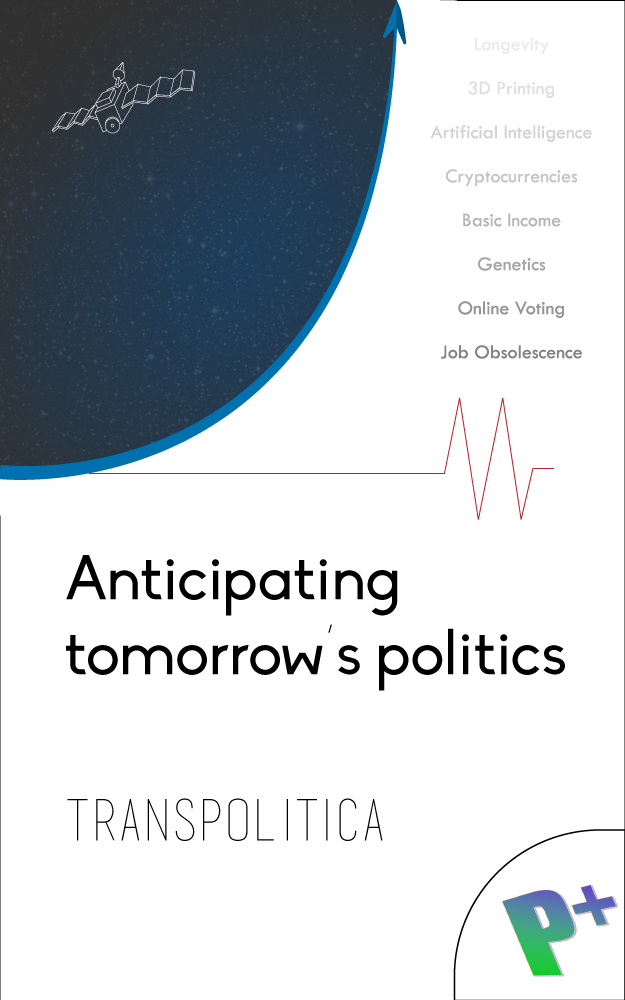
Parliaments digital – “Parliaments digital”

Parliaments rockets – “Parliaments rockets”

Politics topics – “Politics topics”

Westminster perspective – “Westminster perspective”

Westminster rocket – “Westminster rocket”

Many thanks to Transpolitica consultant Alberto Rizzoli for designing these candidate covers.

Note: Transpolitica is using CIVS (Condorcet Internet Voting Service) for this poll. CIVS takes into account relative voter preferences. In this case, the poll is open – anyone with the link can take part. (CIVS also supports private polls, restricted to a given set of email addresses. In both public and private polls, the individual votes are all anonymous.)


Video: Transpolitica Manifesto, for Future Day

This video was recorded in connection with Future Day, which is held each year on 1st March. To quote from http://futureday.org/:

Holidays provide a fantastic way of channeling peoples’ attention and energy.

Most of our holidays are focused on past events or individuals, or on the rhythms of nature. History and nature are wonderful and should be honored — but the amazing future we are building together should be honored as well.

Future Day is a way of focusing and celebrating the energy that more and more people around the world are directing toward creating a radically better future.

This is a brand new holiday — the first Future Day was in 2012. This year on March 1st Future Day will be even better! Let us all work together to continue to make Future Day a great success.

The video is the first in a series addressing aspects of the Transpolitica Manifesto. To be notified whenever a new video is available, click the “Follow” button that appears at the bottom right hand corner of this WordPress page.

Transpolitica News: More questions than answers

Ahead of a Transpolitica coordination hangout that’s taking place tomorrow, Monday 16th Feb (7pm-8pm UK time), here’s a brief update on recent P+ developments.

Note: to receive these news updates directly into your email inbox, visit this page online at https://transpolitica.org/news/ and click the “Follow” button that appears at the bottom right hand corner of the screen.

Three meetings, each creating more questions than answers

Since the first Transpolitica News post, on 28th Jan, Transpolitica has hosted two Hangout-On-Air video discussions, and our sister organisation London Futurists has hosted an IRL (In Real Life) event on a topic of strong interest to Transpolitica:

  • The discussion on 1st February was “The case for anarchist transhumanism”, considering the potential for radical social decentralisation
  • On 8th February the topic was “Better political decision-making via better technology?”
  • On 14th February, London Futurists focused on “The case for Universal Basic Income”

In all three cases, the discussion made it clearer that these are areas which are:

  • Important – in view of the transformational potential of technology
  • Insufficiently studied by mainstream political parties
  • Unclear, in terms of what specific policy recommendations should be made.

In short, they’re all areas where Transpolitica researchers could usefully carry out some potential ground-breaking analysis that could, in turn, give transhumanist politicians some distinctive policy initiatives.

In the meantime, there are more questions than answers – but perhaps the chapters in the forthcoming Transpolitica book will start to provide good answers…

Progress with “Anticipating tomorrow’s politics”

There’s been little news over the last two weeks of progress with chapters for “Anticipating tomorrow’s politics”. The status of various chapters, to the best of our knowledge, is as follows:

  • One chapter has been submitted in completed form, has received feedback from a reviewer, and is now being revised by the author
  • Fourteen chapters have had their abstracts accepted, and, in principle, the authors should be making good progress in writing the content
  • Six more authors have said they may be writing a chapter
  • One author has officially withdrawn his suggested chapter, in view of pressures of work-commitments.

According to the published schedule, completed chapters should be in the hands of the editors by the end of February – which is in two week’s time. This is, deliberately, a bold schedule, since that’s more likely to trigger a productive state of flow in the minds of authors – and, as a result, some truly great output.

(Yes, this attitude is in line with the content of the book Bold: How to Go Big, Create Wealth and Impact the World” by Peter Diamandis and Steven Kotler. That book is about 80% inspiration, along with 20% – say it quietly – of over-hype. Given the value of the 80% that is deeply inspiring, the book can be forgiven for the 20% where the authors’ enthusiasm produces a reality-distortion zone.)

In the meantime, there’s now a suggested book cover for the Transpolitica book:

PpB Cover

See the end of https://transpolitica.org/projects/book-project/ for more details about this cover design.

Supporting political candidates in their election campaigns

The two sets of politicians where Transpolitica is ready to help specific election campaigns are

Darren is creating a brochure which will be distributed through letter boxes within his constituency. Current thinking is that this will contain short articles on the future of transport and the future of healthcare. Transpolitica researchers should be able to help in both cases.

A broader question arises of the extent to which “online activism” can usefully replace or supersede the traditional sort of doorstep and letter box activism:

  • Are people who pursue online activism better described using the critical term “slacktivists”, meaning that their activity has little impact in the real world (even though it may make them feel good)?
  • Or can online activism, suitably tailored and targeted, have a big impact on voting intentions?

Unless a clear argument can be made to the contrary, the intention is that Transpolitica will become expert in practical online activism, via understanding how to use accelerating technology for the most effective impact on election outcomes.

Next steps in evaluating the readiness of politicians for radical future scenarios

One of the core ideas behind the founding of Transpolitica is to provide a “mirror” that will allow politicians of all parties to realise where they fall short as regards being aware of the opportunities and threats posed by rapidly accelerating technology.

As stated in the Transpolitica manifesto:

Current policymakers rarely tackle the angle of convergent disruptive technologies. This means they react to each new disruption with surprise, after it appears, rather than anticipating it with informed policy and strategy.

Politicians of all parties urgently need to:

  • Think through the consequences of these changes in advance
  • Take part in a wide public discussion and exploration of these forthcoming changes
  • Adjust public policy in order to favour positive outcomes
  • Support bold regenerative projects to take full advantage of accelerating technology – projects with the uplifting vision and scale of the 1960s Apollo moonshot program.

The “mirror” mentioned above is envisaged to be a combination of:

  • The Transpolitica manifesto
  • White papers that amplify parts of that manifesto
  • Evaluation studies which compare the stated policies of other politicians (either singly, or as bundled into party manifestos) against the Transpolitica blueprint.

Transpolitica Consultant Alex Karran has been continuing his very interesting research work into evaluating the viewpoints of politicians in the UK. What is needed next is some decisions about the best way to take this research forward:

  • Possibly featuring as a chapter within the Transpolitica book
  • Possibly featuring in one or more short videos, intended for easy distribution
  • Possibly featuring in one or more online reports (perhaps on the Transpolitica website).

Online decision processes within Transpolitica

Activity within Transpolitica’s Loomio project has slowed significantly. At the time of writing, it is 13 days since there was any activity there.

It’s not clear if this slowdown reflects shortcomings in the tool, or (instead) the fact that we don’t have anything sufficiently contentious to decide yet.

We are open to trialling another decision-making tool, if someone makes a case that a particular tool is more likely than Loomio to facilitate high-quality decision-making.

An IRL launch event in the UK?

A possible IRL launch event, probably in London, could take place, that marks:

  • The e-availability of the Transpolitica book
  • The start of the official campaign of a UK General Election candidate for the Transhumanist Party.

Previously, the date of 21st March has been suggested for a launch event. No firm decision has been taken yet.

Transpolitica impact outside of the UK

Due to circumstances behind its formation, Transpolitica’s engagements with political parties are initially dominated by the run-up to the UK General Election of May 2015. However, Transpolitica is keen to expand its activities with other politicians in other countries – subject to:

  • Transpolitica consultants being available to work on such relationships
  • Specific politicians being identified that have clear areas where Transpolitica could supply support.

Participation in Transpolitica coordination hangouts

Please let us know if you would like to receive invites to forthcoming coordination hangouts. These hangouts include:

  • Progress reports, along with issues arising, from individual Transpolitica consultants
  • Coordination of what Transpolitica consultants are planning to work on next
  • Collaborative decisions on particular questions (these questions will vary from hangout to hangout).

The next coordination hangout is taking place on Monday 16th February. After that, the most likely date is Monday 23rd March.

Transpolitica News: Getting started

A great deal has happened in the ten days since the soft launch of Transpolitica. Here’s the first of what will become a series of updates on Transpolitica progress.

Note: to receive these news updates directly into your email inbox, visit this page online at https://transpolitica.org/news/ and click the “Follow” button that appears at the bottom right hand corner of the screen.

Manifesto

After an initial flurry of changes, the Transpolitica Manifesto has now been relatively stable for about a week. This manifesto sets out core ideas for policy changes:

Transpolitica calls upon politicians of all parties to define and support:

  • Regenerative projects to take full advantage of accelerating technology.

More specifically, we call for:

  • Economic and personal liberation via the longevity dividend
  • An inclusive new social contract in the light of technological disruption
  • A proactionary regulatory system to fast-track innovative breakthroughs
  • Reform of democratic processes with new digital tools
  • Education transformed in readiness for a radically different future
  • A progressive transhumanist rights agenda
  • An affirmative new perspective on existential risks.

These Headlines are preceded in the manifesto by a Preamble, and all eight Headlines are backed up by the provision of further Details.

The Transpolitica Manifesto drew inspiration from the Technoprogressive Declaration that was published in November 2014 following the TransVision 2014 conference in Paris. In turn, our Manifesto has helped to inspire a number of other political statements, including:

In parallel, the Transhumanist Party (UK) is working on its own set of Transhumanist Party Principles.

There’s an opportunity to improve the contents of the Transpolitica Manifesto in the light of the good examples provided as these other documents develop.

Another important step forward will be when the Transpolitica Manifesto is turned into one or more videos, in order to reach a wider audience.

FAQ

The Transpolitica Manifesto is backed up by a FAQ. The FAQ remains a work-in-progress. If anyone would like to propose changes or additions to the FAQ, please get in touch.

How to get involved in Transpolitica projects

The Transpolitica Projects page lists:

  • A set of tasks awaiting volunteers
  • Suggestions for how to discuss your ideas with other Transpolitica supporters.

Book project

The project which currently has the most activity is to publish our first book of essays:

Transpolitica invites political thinkers, futurists, and transhumanists from around the world to become involved in a project to publish a book entitled “Anticipating tomorrow’s politics”.

This project is looking for chapter authors, reviewers, editors, and graphic designers.

Since the call was issued for people to submit proposals for chapters:

  • One complete chapter has already been submitted, in a publication-ready state
  • Seven other authors have submitted abstracts (formal or informal) that have been approved to go forwards to the writing stage
  • Six more people may be submitting abstracts (or revised abstracts) shortly – we await further information
  • A small number of initial author submissions have been declined, sorry, though these authors are welcome to re-submit proposals taking account of the feedback.

The stated deadline for submitting chapter abstracts (just a few sentences will suffice) is the end of January. Some submissions may be accepted after that cut-off, though the later authors leave things, the harder the hurdle they will have to overcome.

In all cases, complete publication-ready material for the chapter needs to be in the hands of the Transpolitica team by the end of February.

If anyone would like to join the team that reviews submissions, proposes edits (if needed), suggests changes to layout and graphics, etc, please make contact. (And see below for suggestions for the book cover.)

Asking the right questions

Reflections about Transpolitica – especially in the light of ideas for book chapters – show that we’re not yet in a position to advocate detailed policy recommendations. We don’t have all the answers, so far.

Over time, detailed policy recommendations will emerge. But for now, what we can – and should – do, is the following:

  • Highlight future scenarios, that deserve more consideration
  • Ask the key questions, that will transform contemporary political debate.

It is our insight as transhumanists and radical futurists that gives us the collective ability to do both of these things. In this way, we can make a cosmic dent in the political process.

Social media

What’s your favourite social media? Transpolitica online presence is growing:

On LinkedIn, there’s already been a small discussion about Transpolitica in response to a blogpost there. Transpolitica also exists as a company on LinkedIn – it’s listed as a “think tank”. See https://www.linkedin.com/company/9267587. If you’re one of the people listed on the (forthcoming) Transpolitica website page “Consultants, writers, and researchers”, feel free to add an item to your LinkedIn entry for your affiliation with Transpolitica.

Consultants, writers, and researchers

The co-founding team for Transpolitica will be announced shortly.

If you are interested in becoming involved, introduce yourself on the Transpolitica mailing group, stating what you would like to contribute to Transpolitica.

Alternatively, send an email to the Transpolitica programme management team.

Note: in the start-up phase, Transpolitica is operating with zero cash-flow, and all positions are voluntary.

The following list gathers some criteria for people to be considered as a named consultant, writer, or researcher for Transpolitica:

  1. Track record of producing interesting, well-researched material
  2. Able to finish agreed projects within agreed deadlines
  3. Strong public support in favour of transhumanist ideals
  4. Responsive to changing circumstances – practices agile working methods
  5. Doesn’t need a complex support infrastructure – practices lean working methods
  6. Able to disagree with people in a respectful, constructive way, rather than resorting to abuse
  7. Avoids publishing material that is likely to damage the good name of Transpolitica.

Note: people can use aliases for their Transpolitica persona, if they have good reasons to avoid using their official names.

Applications are welcomed from people with all political allegiances (or none), all religious backgrounds (or none), all employment and education backgrounds (or none), all parts of the world, and all ages and genders, etc.

Transpolitica decision-making

How should decisions be made inside Transpolitica? How can we “be the change we want to see”, taking advantage of the latest technology to practise better collaborative decision-making?

We’re currently experimenting with the online tool Loomio. To quote from https://www.loomio.org/about:

Loomio emerged when activists from the Occupy movement teamed up with the social enterprise network Enspiral, realising that they were using different approaches to work towards the same aim.

Loomio is being built by a core team in Wellington, New Zealand, and a wider network of friends and supporters all over the world.

Loomio organises decisions into “Discussions”. These discussions start off with context and a loose brainstorming give-and-take. Once someone has a firm proposal in mind, they click the “Create a proposal” button, and give the group a fixed amount of time to vote on it. (48 hours seems sufficient.) By design, each discussion can only have one live proposal at any one time. That can seem counter-intuitive, but it turns out to have its own merits.

It’s too early to tell whether Transpolitica will keep on using Loomio. Our experiences with it, so far, have not been decisive, one way or the other. There are many other tools we could trial, as alternatives – each with their own apparent pluses and minuses.

In the meantime, there’s a new Discussion on the Loomio board – “Book cover”. To view that discussion, and to contribute to it, you’ll need to:

  1. Create a Loomio account for yourself (if you don’t have one already)
  2. Request permission to join the Transpolitica group on Loomio.

(If you click on the above link, “Book cover”, Loomio should walk you through the process automatically.)

Hangouts-on-Air

Another Transpolitica initiative is to host online video discussions relevant to the future of politics. People can view these discussions live (and ask questions to the panelists), or can catch up with the recordings afterwards. Two forthcoming events are as follows:

If you visit the corresponding Google+ event pages and RSVP ‘Yes’, Google will send you a reminder to join it.

Let us know which topics (and which participants) it would be good to feature in future Transpolitica Hangouts-on-Air.