Transpolitica 2016 – Schedule

Real world policy changes for a radically better future

Note: videos and slides from the various presentations are embedded below.

The schedule for the one-day conference “Transpolitica 2016” – which took place in Central London on Saturday 3rd December – is as follows:

transpolitica-2016-speakers-v4

09.15: Doors open

We’ll be in the Clore Management Centre, room B01 (on the basement level), Birkbeck College, Torrington Square WC1E 7HX, London.

clore-management-centre

The Clore Management Centre is on the opposite site of Torrington Square from the main Birkbeck College building. Torrington Square (which is a pedestrian-only square) is about 10 minutes walk from either Russell Square or Goodge St tube stations. See this map.

To register in advance for this event, see this meetup page.

Note: Tickets for Transpolitica 2016 cost £18. (The entrance fee has been chosen so as to cover the costs of room hire, refreshments, and AV and IT expenditure. Early bird tickets, costing £15, and super early bird tickets, costing £12, are now all sold out.)

09.40: Introductory videos

09.45: Chair’s opening remarks

David Wood, Executive Director, Transpolitica: “What prospects for better politics?” – slides

10.00-12:00: Regulations, health, and transformation

Alex Flamant, Notion Capital: “Accelerating the regulatory approval of autonomous vehicles”

Anna Harrington Morozova, Scientific and Regulatory Director, REGEM Consulting: “Opportunities for changes in governance of biomedical innovations: choosing your battles” – slides

Didier Coeurnelle, Co-president of Heales, “Making longevity politically mainstream, or die trying” – slides

Alex Pearlman, Science Journalist, Kings College London: “The political future of genetic enhancements” – slides

José Cordeiro, Founding Energy Advisor/Faculty, Singularity University: “Practical and legal steps towards European cryonics” – slides

12.00: Break for lunch and networking (lunch is not supplied)

This Google Map lists selected restaurants and coffee shops that are within around 10 minutes walk from the conference venue – providing a wide choice of options for lunch.

13:00: Tea and coffee available, for post-lunch networking

Light refreshments will be available in the entrance foyer outside the meeting room.

13:30-15:10: Politics, tools, and transformation

Timothy Barnes, Founder and Senior Deity, The Rain Gods: “Bringing digital disruption to government”; Kathryn Corrick, COO Represent.me, “Updating democracy”; Dan Brown, Director of Meganexus Ltd: “ICT tools for computational government”

James Smith, Party Leader, Something New: “Building the world’s first open-source political manifesto” – slides

Jason Blackstock, Head of Department, UCL STEaPP, “Practical steps towards better public decision-making” (this speaker used no slides)

15:10: Break for tea/coffee networking

Light refreshments will be available in the entrance foyer outside the meeting room.

15.40-17.30: Society, data, and transformation

Alexander Karran, Senior Researcher, Transpolitica: “Surveillance capitalism: making big data work for all” – slides

Tony Czarnecki, Managing Partner, Sustensis: “From long-term sustainable growth to the economy of abundance” – slides: as presented; as revised after the talk

Dean Bubley, Founder, Disruptive Analysis: “Technological Unemployment? We can work through it” – slides

Chris Monteiro, Principal contributor, H+Pedia: “Perceptions and projections of futurist political scenarios” – slides

17.30: Room empty

The event will be followed by a chance to continue the discussion in a nearby pub – The Marlborough Arms, 36 Torrington Place, London WC1E 7HJ.

Online discussion

In the spirit of embracing technology to improve collaboration, Transpolitica 2016 will be trialling a tool (Glisser) for online communication during the event. This tool will be used to identify the questions that the audience, as a whole, prioritise as most deserving responses from speakers.

The tool can be accessed using either a cellular (3G/4G) connection or via wifi. For more details, see here.

Wifi details for attendees at this event are as follows:

Wireless network: BBK-Guest
Username: Londonfuturists2
Password: bbP7jW
(This access code is operational only from 09.00-17.30 on 3rd December.)

Registration and preview

To register for this event, see this meetup page.

And see here for a short video preview.

Transpolitica 2016 – call for submissions

Transpolitica plans to hold a one-day conference in central London on Saturday 3rd December 2016 (10am-5pm).

(Update: see here for the latest plans for Transpolitica 2016, and how to register to attend.)

The theme of the conference is “Real world policy changes for a radically better future“.

Transpolitica 2016

The goal of the conference is to formulate and review policy recommendations which could become the focus of subsequent cross-party campaigns for legislative changes. In turn, these legislative changes will have the aim to enable better politics, better communities, and better human experience – by allowing society to take good advantage of the remarkable transformational potential of accelerating technologies.

The conference invites submissions from people interested in presenting TED-style thought leadership presentations at the event. These presentations should last 15-20 minutes and should convey key practical thoughts to stimulate group discussion during a Q&A period after the talk.

Suggested topics include:

  • Transitional steps towards Universal Basic Income
  • Alternative responses to the possibility of Technological Unemployment
  • Legal support for self-experimentation with nootropics
  • The political future of genetic enhancements
  • Policy changes that encourage quicker development of anti-aging therapies
  • Improvements to how finance works
  • Improvements to democracy and decision-making
  • Policy changes regarding surveillance, privacy, and data ownership
  • Support for radical decentralisation: cryptocurrencies, blockchain, and more
  • The role of politics in accelerating science and innovation
  • The role of politics in responding to existential risks
  • Beyond national sovereignty: The evolution of transnational governance

If you’re interested in submitting a proposal to speak, or have any other suggestion about the event, please email the event organisers – the sooner, the better – ideally by 11th September (so that the agenda can be publicised in good time).

Notes:

  • The date of 3rd December is currently the strong favourite, but might be changed (one week in either direction) if any clashing events become known to the organisers over the next few days
  • Although the event is held in London, speakers are welcome to propose changes to politics happening anywhere in the world
  • The organisers welcome suggestions for logos, graphics, banners, or other publicity material to help spread word about Transpolitica 2016.

Flawed humanity, flawed politics

Evolution is a many-splendoured thing. Our long evolutionary history has prepared us well for many aspects of modern life. But in other aspects it bequeaths us problems. Nasty problems.

One example is our sweet tooth. Our ancestral instinct to eat plenty of fruit (or things that taste like fruit), in anticipation of subsequent times of lean, leads in the modern age to an epidemic of obesity. Oops.

Another example is our tendency to imagine intelligent agency where none exists – our so-called “hyperactive agency detector”. A rustle in the leaves; a cracked twig; a bolt of lightening – were these mere accidents, or the signs of a crafty predator? Better to be safe than sorry. But that hyperactive agency detector gave rise to numerous fantasies, worldwide, of ghosts and demons and supernatural deities. Double oops.

And yet another example is our tribalism – our innate apprehension of “the other”. We learned to fear alien groups of people who were noticeably different from our closer circle, and who might be expected, given a chance, to double-cross us or stab us in the back. Once upon a time, a rule of thumb “beware the outsider” was doubtless useful for survival. But in present times, that xenophobia can have all kinds of adverse consequences. Oops again.

What does this have to do with 21st century politics? Plenty!

evolution-24560

Four versions of tribalism

As I’ll list shortly, four of the most destructive tendencies in modern social life have their roots in our apprehension of “the other”. In each case, our social harmony is warped by ideologies that reinforce our innate tendency to fear those who seem different from ourselves. In each of the four cases, an ideology tells its adherents that there are deep reasons why the leopard cannot change its spots – why, that is, the outsiders are bound to keep on behaving in dangerous, destructive ways. So the ideology exacerbates the mistrust.

Look at these strange folk, the ideology says. Look at him here, and her there. These specific individuals are undeniably bad. And the rest are all the same. We – the decent, normal people – need protection against the entire tribe of others. We need to take back control – so these ideologies tell us, in various different ways.

These ideologies find willing listeners. Our subconscious minds are grateful for intellectual rationales that can be adopted, that shore up our instinctual urges, regardless of whether these urges remain good for us.

The first case is nationalism, or its variant, racism. Some English are duplicitous, therefore all English are duplicitous – that is (more or less) what I remember my barber telling me, on more than one occasion, when I had my hair cut as a teenager in Aberdeenshire in the mid 1970s. Other nationalists of a different stripe might say, in retort: some Scots are mean, therefore all Scots are mean. Some African Americans are lazy and disrespectful, therefore all African Americans are lazy and disrespectful. Some Moslems are fanatics, therefore all Moslems are fanatics. Some Poles are welfare scroungers, therefore all Poles are welfare scroungers. And so on.

Stated in such bald terms, the ideology is evidently puerile. But it is typically dressed up with finer trimmings. The reason why the other is likely to behave badly, we are told, is because they are victims of their culture, and (in some cases) victims of their religion. The ideology asserts – correctly, in my view – that some cultures are inferior to others, and that poor cultures can be kept in place by tendencies within religious teachings. For example, when a holy book emphasises that women are deeply different from men, we should not be surprised if people enmeshed in the resulting culture give scant attention to female equality. And if that holy book elevates faith as a virtue high above honest doubt, it’s no wonder that the members of that culture are inclined towards fanaticism.

The key question is: how easy is it for people to step aside from the culture in which they were previously enmeshed? Ideologies of nationalism tend to be sceptical on that count. In that view, culture is deterministic, and diminishes the capacity of “the other” to change. Forget any hopes of multi-cultural harmony. Instead, build walls.

The second case is anti-capitalism. That’s a bit more sophisticated than nationalism, but not by much. This line of thinking goes as follows: some business owners are ruthless profit-seekers, therefore all business owners are ruthless profit-seekers. Anyone who claims to be a “conscious capitalist” or a “moral capitalist” is deluding themselves. Their prevailing culture – the system of shareholder contracts and imperatives to maximise profits – ensures that they cannot really change. Therefore the “decent, normal people” – the working class – need to seize power, seize the means of production, and (if need be) string up the recalcitrant capitalist class from the lampposts.

Yet again, it’s an ideology that can find ready adherents. Developed under the label Marxist-Leninism, it’s an ideology that has caused horrible upheavals around the world.

The third case is the widespread rigid displeasure at EU bureaucracy.  Here’s the thinking: some EU bureaucrats are faceless self-serving empire-builders, therefore all EU bureaucrats are faceless self-serving empire-builders. As before, the argument runs from the specific to the general. A business leader finds his growth plans thwarted by ill-conceived regulations handed down imperiously from Brussels, therefore we have to take back control of all regulations handed down from Brussels. An innovative medical intervention is stymied by slow-moving EU healthcare review processes, therefore we have to take back control of all review processes from the EU. Perhaps we should even string up the leaders of that bureaucracy from the lampposts.

The key question in this case is: what stands in the way of intelligent reform of the EU bureaucracy? One answer is that the EU bureaucracy is part of a gigantic self-perpetuating system which is incapable of reform – much the same as Marxists claim that capitalism is incapable of meaningful reform. People with bad personal experiences of EU bureaucrats are, not surprisingly, sympathetic to that ideology.

What makes that line of thinking more likely to be accepted, alas, is the dearth of adequate positive communications about:

  • The rich benefits achieved from EU membership (despite a steady stream of mistakes being made)
  • The history of positive evolution of EU governance (despite the delays in some of these steps being taken).

Too many people have gained, in the short term, by spreading “bad news” stories (often wildly exaggerated) about EU governance. These stories have been good fun – ha ha ha – until they weren’t. Oops.

That takes me to the fourth case: rigid displeasure of government. It’s worth some extra attention.

Monkeys_1920

The case for governments

What is the point of governments?  Governments provide social coordination of a type that fails to arise by other means of human interaction, such as free markets.

Markets can accomplish a great deal, but they’re far from all-powerful. Governments ensure that suitable investment takes place of the sort that would not happen, if it was left to each individual to decide by themselves. Governments build up key infrastructure where there is no short-term economic case for individual companies to invest to create it.

Governments defend the weak from the powerful. They defend those who lack the knowledge to realise that vendors may be on the point of selling them a lemon and then beating a hasty retreat. They take actions to ensure that social free-riders don’t prosper, and that monopolists aren’t able to take disproportionate advantage of their market dominance.

Governments prevent all the value in a market from being extracted by forceful, well-connected minority interests, in ways that would leave the rest of society impoverished. They resist the power of “robber barons” who would impose numerous tolls and charges, stifling freer exchange of ideas, resources, and people. Therefore governments provide the context in which free markets can prosper (but which those free markets, by themselves, could not deliver).

What I’ve just described is a view of governments which is defended by the most frightening book I’ve read this year. The book is “American Amnesia: How the War on Government Led Us to Forget What Made America Prosper”. The authors are the political scientists Jacob S. Hacker and Paul Pierson.

American Amnesia_1280

In describing this book as “frightening”, I don’t mean that the book is bad. Far from it. The authors’ characterisation of the positive role of government is, to my mind, spot on correct. It’s backed up by lots of instructive episodes from American history, going all the way back to the revolutionary founders.

But what’s frightening is another set of information clearly set out in the book:

  • The growing public hostility, especially in America (but shared elsewhere, to an extent) towards the idea that government should be playing any significant role in the well-being of society
  • The growing identification of government with self-serving empire-building bureaucracy
  • The widespread lack of understanding of the remarkable positive history of public action by governments that promoted overall social well-being (that is the “amnesia” of the title of the book)
  • The decades-long growing tendency of many in America – particularly from the Republicans – to denigrate and belittle the role of government, for their own narrow interests
  • The decades-long growing tendency of many others in America to keep quiet, in the face of Republican tirades against government, rather than speaking up to defend it.

The risk ahead

I listened to the concluding chapters of American Amnesia during the immediate aftermath of the referendum in the UK on the merits of remaining within the EU. The parallels were chilling:

  • In the EU, the positive role of EU governance has been widely attacked, over many decades, and only weakly defended. This encouraged a widespread popular hostility towards all aspects of EU governance
  • In the US, the positive role of US governance has been widely attacked, over many decades, and only weakly defended. This encouraged a widespread popular hostility towards all aspects of US governance. The commendable ambitions of the Obama government therefore ran into all sorts of bitter opposition.

The parallels might run one step further. To me, and many others, it was almost unthinkable that the referendum in the UK would come down in favour of leaving the EU. Likewise, it’s unthinkable to many in the US that Donald Trump will receive a popular mandate in the forthcoming November elections.

But all bets are off if the electorate:

  1. Feel sufficiently alienated
  2. Imbibe a powerful sense of grievance towards “the others” who are perceived to run government
  3. Lack a positive understanding of the actual role of big government.

Dealing with the flaws

Given the three risk factors I’ve just listed, various counter-measures ought to be clear:

  1. Action is required towards the concrete factors that generate a sense of alienation. Rather than the fruits of economic success being channelled to a small fraction of society, with growing inequalities, we need powerful steps for greater inclusion and wider participation.
  2. Language that encourages grievance must be rooted out. Whenever pundits present distorted stories about “the other”, these stories should be strongly challenged.
  3. Education is long overdue about the positive role of big government – as a kind of “visible hand” that complements the famous “invisible hand” of the free market.

On the third point, I particularly like the formulation of Hacker and Pierson that the mixed economy was the most important social innovation of the 20th century:

The mixed economy spread a previously unimaginable level of broad prosperity. It enabled steep increases in education, health, longevity, and economic security.

That’s an insight with a lot of mileage.

However, none of the above three tasks is easy. They’re made harder by the deep-rooted tendencies inside the human spirit to tribalism – ugly tendencies that keep coming to the surface in contemporary debates over politics.

In turn, we’re often maintained in our tribal thinking by yet another legacy hangover from our evolutionary heritage. That’s the heritage of a human propensity for self-deception.

The poison of self-deception

Time and again, as I’ve read what friends of mine have written online in recent months, I’ve gently sighed to myself: these people are surely deceiving themselves. (And no doubt I am similarly guilty on many occasions!)

Indeed, as the giant of evolutionary theory Robert Trivers explains in his genre-defining 2011 book “Deceipt and Self-Deception: Fooling Yourself the Better to Fool Others”,

We deceive ourselves the better to deceive others, and thereby reap the advantages.

Our subconscious minds often work hard to prevent our conscious minds seeing the whole picture and thereby disturbing our equanimity:

However much we champion freedom of thought, we actually spend much of our time censoring input. We seek out publications that mirror or support our prior views and largely avoid those that don’t.

Robert Trivers Deceipt

Trivers also provides this telling observation:

The great sage Thales once put the general matter succinctly. “Oh master,” he was asked, “what is the most difficult thing to do?” “To know thyself”, he replied. “And the easiest?” “To give advice to others.”

Towards a better intelligence

As a transhumanist, I look forward to a time in the hopefully not-too-distant a future when we’ll be smarter, not only rationally, but also emotionally.

But that I mean that our conscious minds will have a clearer understanding of the factors leading us to espouse various beliefs and ideologies. I’m sure we’ll all have some rude shocks in the process (me included).

With that clearer understanding, we’ll have a chance to resolve our political debates in a more rational way – a way that avoids unnecessary tribalism and alienation. Better humanity can provide the gateway to better politics.

Whence comes this better emotional intelligence? That’s perhaps the biggest question of all. Smart drugs may contribute. So might improved meditation techniques, or digital nootropics (such as helmets that modulate the brain via electrical stimulation). Enhanced communities of emotional support are likely to play a key role too.

Butterfly_1920

Article by David W. Wood, Executive Director, Transpolita

The graphics images are from Pixabay (click to see the individual sources.)

Anticipating better democracy

Democracy is one of the great triumphs of civilisation. But the way democracy is practised, in the UK and in the wider world, leaves a great deal of room for improvement.

In short, recent events show the risks of populism, which is a perversion of democracy.

Can we improve democracy, so that it avoids the siren allure of populism? Can we take steps so that the best insights of the entire population rise to the top of political discussion, rather than being buried in a sea of confusion, rumour, innuendo, and downright lie?

In an age with increasingly rapid communications, and with growing alienation of large parts of society, these questions are pressing. This article is the first in an envisaged Transpolitica series, “Anticipating better democracy”, that tries to catalyse some answers.

There’s more to democracy than majority decision-making

Democracy is a system where the majority decides. It’s where leaders need the approval of the citizenry. But it’s not mob rule.

Democracy allows the majority to appoint leaders. But it does not permit the majority to ride roughshod over the opinions of the minority. It avoids placing absolute power into the hands of the winning coalition. The minority have important rights too.

Democracy enables political disagreements to be handled by discussion rather than by physical force. It avoids the powerful retaining power simply via their ability to summon armies and command the police. It allows the citizenry to vote leaders out of office, once these leaders no longer have sufficient popular support. Democracy therefore addresses the dangerous human trait in which people who have risen to a position of power tend to become overly confident in their own abilities, surround themselves by yes men, veer towards autocracy, and brook no dissent. Done right, democracy allows the opposition to speak truth to power.

To be clear, democracy is more than the simple fact of an election. Democracy is about the climate that prevails, both in the run-up to an election, and in its aftermath.

A democratic transition

To avoid a region descending into chaos after an election takes place, democracy requires the loser of an election to swallow hard, congratulate the victor, and to stop contesting the result.

John McCain concession speech

For example, when John McCain realised in the early morning of 5 November 2008 that he had lost the US Presidential election to Barack Obama, he called upon his own supporters to recognise that Obama was a good man:

My friends, we have come to the end of a long journey. The American people have spoken, and they have spoken clearly. A little while ago, I had the honor of calling Sen. Barack Obama — to congratulate him on being elected the next president of the country that we both love.

In a contest as long and difficult as this campaign has been, his success alone commands my respect for his ability and perseverance. But that he managed to do so by inspiring the hopes of so many millions of Americans, who had once wrongly believed that they had little at stake or little influence in the election of an American president, is something I deeply admire and commend him for achieving…

Sen. Obama has achieved a great thing for himself and for his country. I applaud him for it, and offer my sincere sympathy that his beloved grandmother did not live to see this day — though our faith assures us she is at rest in the presence of her Creator and so very proud of the good man she helped raise.

Sen. Obama and I have had and argued our differences, and he has prevailed. No doubt many of those differences remain. These are difficult times for our country, and I pledge to him tonight to do all in my power to help him lead us through the many challenges we face.

I urge all Americans who supported me to join me in not just congratulating him, but offering our next president our goodwill and earnest effort to find ways to come together, to find the necessary compromises, to bridge our differences and help restore our prosperity, defend our security in a dangerous world, and leave our children and grandchildren a stronger, better country than we inherited…

Some of his supporters booed, on hearing these words, but McCain proceeded:

Tonight — tonight, more than any night, I hold in my heart nothing but love for this country and for all its citizens, whether they supported me or Sen. Obama. I wish Godspeed to the man who was my former opponent and will be my president.

Nevertheless, whilst a democratic decision provides a milestone landmark, it’s not necessarily the end of the journey. The party that lost an election does not vanish into nonexistence. There is no iron law of democracy that says a losing party must give up its ideological understanding once the voters have spoken against it. Instead, it can regroup, and be ready to offer a renewed understanding to the electorate in the changed circumstances of the future.

Changing circumstances

In some cases, it may not take long for circumstances to change. This is especially the case when a democratic decision has taken place in a particularly confusing environment, and where greater clarity emerges soon after the vote has taken place. In such a case, the voters may justifiably feel angry about being deceived by the way the campaign was conducted.

In this article, I’ll avoid focusing too closely on the contentious circumstances of the recent EU exit vote in the United Kingdom. Opinions clearly differ, forcibly, on that score. I’ll just note in passing that even Kelvin Mackenzie, former long-time editor of the right-wing Sun tabloid newspaper, has expressed his own “buyer’s remorse” for voting for the UK to leave the EU (despite having previously campaigned hard for that outcome).

Kelvin MacKenzie remorse

Circumstances are changing fast.

But let’s concentrate, for now, on some steps that might be taken to improve the calibre of democratic decision-making – steps that might avoid future examples of widespread voter regret (and major voter distress). I’ll consider two suggestions.

Holding politicians to account?

The Advertising Standards Authority has firm rules about the kinds of claims that companies can make in their advertisements. Thank goodness.

But no such rules apply to the claims that politicians make, in their campaigns. Columnist Alan Travis observes as follows, in his recent article “The leave campaign made three key promises – are they keeping them?”

While legal action can follow in the case of a commercial contract or the public flotation of a company if false statements are made in, there is no advertising code that requires political statements to be “legal, decent, honest and truthful”.

It’s tempting to ask: Why not?

If politicians knowingly bend the truth, in ways that wouldn’t be allowed in commercial communications, and major financial damage results, shouldn’t they be sued as a result?

However, I see this as potentially dangerous ground. The threat of being sued could clamp down on free speech.

To make this work, the emphasis would have to be on evidence that the politician definitely knew their claims were wrong, but went ahead with them regardless.

Before we get to that point, we can accelerate an important recent political trend. That’s the trend of improved, quicker fact-checking.

Fact-checking politicians’ claims

One of the most impressive organisations I’ve encountered recently is Full Fact – which describes itself as “the UK’s independent factchecking organisation”.

Full Fact Logo

Their website continues:

We check claims made by politicians, the media, pressure groups, and other voices in public debate, and push for corrections where necessary. We also work with government departments and academic research institutions to improve the quality and communication of technical information at source, and campaign for greater transparency in the public arena.

We don’t support any view or political party. Our mission is to improve the quality of public debate, and to equip the public with the best information possible to make up their own minds. We provide links to all our sources so that you don’t have to take our word for anything – you can also check for yourself.

Our commitment to transparency extends to our funding…

In a profile article, the Financial Times gave a couple of examples of claims checked by Full Fact:

Leave’s claim that Britain sent £350m a week to the EU was “wrong” because it ignored the UK budget rebate, it found. The CBI’s claim that membership was worth £3,000 a year to every household was “not credible”; and so on…

In other words, claims on both sides of the debate were found wanting.

Full Fact have accomplished a great deal with only a skeleton team. But with more support (including volunteers, funding, and other resources) there’s much more that can be accomplished.

Of course, much political debate happens in dimensions removed from facts. And facts are often capable of multiple interpretations. So fact-checking, by itself, won’t cure all the shortcomings of our present-day practice of democracy.

But we can anticipate the growth of a fact-checking culture, with the following positive outcomes:

  1. Everyone will come to expect that claims made by politicians are routinely, quickly checked
  2. Alongside phrases like “Google this”, which are already commonplace, we’ll more often hear phrases like “Fact check this”
  3. Politicians who make claims that violate independent fact-checking will be treated as pariahs. (There probably won’t be a need to sue them in courts of law for their wilful misstatements. They will, rightly, fall foul of the court of public reputation.)
  4. Newspapers that make claims that violate independent fact-checking will, likewise, become pariahs.

Fact check true or false

If only…

If that kind of culture had been in place in the past, the misstatements of a certain leading UK politician, from his days as a newspaper journalist covering EU affairs from Brussels, would not have gone unpunished. And the UK may well not have come near its present political crisis. I’m referring to Boris Johnson. As stated by his former journalist colleague Martin Fletcher,

For 25 years our press has fed the British public a diet of distorted, mendacious and relentlessly hostile stories about the EU – and the journalist who set the tone was Boris Johnson.

I know this because I was appointed Brussels correspondent of The Times in 1999, a few years after Johnson’s stint there for The Telegraph, and I had to live with the consequences.

Johnson, sacked by The Times in 1988 for fabricating a quote, made his mark in Brussels not through fair and balanced reporting, but through extreme euro-scepticism. He seized every chance to mock or denigrate the EU, filing stories that were undoubtedly colourful but also grotesquely exaggerated or completely untrue.

The Telegraph loved it. So did the Tory Right. Johnson later confessed: ‘Everything I wrote from Brussels, I found was sort of chucking these rocks over the garden wall and I listened to this amazing crash from the greenhouse next door over in England as everything I wrote from Brussels was having this amazing, explosive effect on the Tory party, and it really gave me this I suppose rather weird sense of power.’

Next steps

Will this cultural change be sufficient to fix the current ails of democracy? Of course not. But it’s an important step in the right direction.

Transpolitica plans to publish more articles on anticipating better democracy. If you’d like to submit a contribution, please get in touch.

Artificial Intelligence in the UK: Risks and Rewards

AKThe following report was created by Transpolitica senior consultant Alexander Karran in response to the ongoing inquiry into robotics and artificial intelligence by the UK parliament’s Science and Technology Committee.

The report was submitted on behalf of Transpolitica, to address the topics listed on the Science and Technology Committee inquiry page:

  • The implications of robotics and artificial intelligence on the future UK workforce and job market, and the Government’s preparation for the shift in the UK skills base and training that this may require.
  • The extent to which social and economic opportunities provided by emerging autonomous systems and artificial intelligence technologies are being exploited to deliver benefits to the UK.
  • The extent to which the funding, research and innovation landscape facilitates the UK maintaining a position at the forefront of these technologies, and what measures the Government should take to assist further in these areas.
  • The social, legal and ethical issues raised by developments in robotics and artificial intelligence technologies, and how they should be addressed.

The author thanks members of Transpolitica and the Transhumanist Party UK for their feedback on previous drafts of this report.

Note: click here to access the entire set of submissions accepted by the Science and Technology Committee.

Robotic handshake

Executive Summary

This briefing introduces Artificial Intelligence (A.I) as it is applied in industry today, and outlines what the United Kingdom can do to take full advantage of the technology. The briefing covers four areas the Implications of robotics and artificial intelligence for the UK, gaining and maintaining primacy in A.I technologies, the social and economic opportunities afforded by A.I technologies and issues in developing robotic and artificial intelligence technologies.

  • A.I is fast becoming an integral part of everyday life. In the coming decades, its integration into the digital ecosystem will be such that almost all technology will have an “intelligent” component.
  • Advances in A.I, robotics, technology and the sciences are approaching an exponential curve due to convergence and driven by information technologies.
  • A.I, robotics and automated processes are highly likely to displace vast amounts of the labour force within the next two decades, potentially 15 million jobs are amenable to automation, by either robotics or software, and cover an ever-broadening range of occupations.
  • Changes in the distribution of the capital-labour ratio will lead to a hollowing out of low, mid and high skill workers.
  • Re-deployment to the work force after a period of re-education and skill improvement may not be possible due to the increased pace of change, requiring a radical rethink of what it means to learn and work in a rapidly evolving digital economy.
  • A basic income should be investigated to offset the reduction in employment opportunities allowing for greater social mobility, a basic standard of living and reduced perception of inequality.
  • There needs to be a radical reform of the national curriculum and educational system to focus above all else on the creative use of technology from an early age, potentially as early as year two and becoming more intensive by year twelve.
  • A.I technologies can be used in the education system to improve the delivery of materials, subject matter and acceptance of A.I. The integration of A.I tools into education is not something that needs to be developed from first principles, but can draw upon the existing field of A.I.Ed
  • Educating citizens at all levels of society about the effects of A.I upon the UK will prove to be the biggest challenge, if the UK is to gain primacy in this area.
  • Defence applications of A.I, robotics and automation require serious consideration and rapid development if the UK government is to vouchsafe its citizens and allies. However, there are ethical and moral considerations and boundaries to be reflected upon.
  • If the UK can respond fast enough and commit to investing in education, digital infrastructure and redeployment of research funding, then coupled with existing industrial and research frameworks the UK is well placed to reap the benefits of becoming a leading player in the A.I domain.

1.    Introduction

  1. Not since the dawn of the industrial revolution in 1750 has there been a period in history that has so radically altered society, economic growth and technological development. Since the start of this revolution, there has been a rapid but linear pattern of growth and development resulting in three distinct eras. The first era was the industrial revolution (mid-18th century), the second was the period of mass industrialisation (mid-19th century), which has now slowed and the third is the Information Technology (I.T) revolution which began in the latter half of the 20th The I.T revolution however, has broken this trend of linear progress and set in motion a period of exponential growth and development. This new revolution, which comes fast on the heels of the previous one, has been termed the fourth industrial revolution[1] or the second machine age[2].
  2. Thus far, this new “digital age” has been characterised by wide adoption of the internet and the creation of so called “cyber-physical” systems -replacing traditional infrastructure with digital technologies- and by convergence, in which the reliance and co-dependence on data driven processes provided by information technologies, is blurring the traditional divisions between scientific and industrial domains. This co-dependence is accelerating scientific and industrial progress in many areas, such as genetic engineering, regenerative medicine and automation driven by advances in robotics and algorithmic control or Artificial Intelligence (A.I).
  3. Advances in A.I have arguably been the principal technology contributing to current progress and one that is evolving in near real-time. A.I is set to become the most advanced technological tool developed by man, since the discovery and use of fire. There are many definitions of artificial intelligence, such as Machine Consciousness, Narrow Artificial Intelligence, Machine Learning, Strong Artificial Intelligence and Artificial General Intelligence. However, for the purposes of this briefing, the focus is upon narrow artificial intelligence applications as these are currently heading into mainstream deployment.
  4. A.I loosely defined, is a set of statistical tools and algorithms that combine to form, in part, intelligent software that specializes in a single area or task. This type of software is an evolving assemblage of technologies that enable computers to simulate elements of Human behaviour such as learning, reasoning and classification. Some examples of A.I include classification algorithms, used to classify images on social media platforms, text mining algorithms and junk email identification to more complex examples used in computational biology and drug discovery, social network analysis, human gameplay and healthcare analytics (such as Google Deepmind and IBM Watson).
  5. In this briefing, we will outline the connotative potential of A.I as a tool to effect radical social change, financial stability and growth and an enhancement or declension of human existence. Our aim is to rationally consider the negative implications of A.I based on available evidence and opinion, while at the same time emphasising the benefits of the technology when ethically applied so that every UK citizen can be given the opportunity to live better than well, which is our mandate.

2.    Implications of robotics and artificial intelligence on the future UK

  1. If the 1st industrial revolution was characterised as a race between technology, labour and education, the 4th may well be categorised as a race against technology that replaces both brains and brawn. This next race has serious implications for education, especially given the current plans to replace state schools with a broad, enforceable national curriculum, with academies that focus on education as product. However, the greatest area of impact will be upon employment, recent research completed by the Bank of England[3] amongst others[4] shows that up to a third (potentially 15 million) of jobs are amenable to automation, by either robotics or software and cover an ever-broadening range of occupations.
  2. The eventual effect of automation will be the creation of an “autonomous economy[5]” in which digital processes talk to other digital processes and synergise to create new processes; this will allow industries to employ fewer workers, yet complete more work. Traditional trend mappings of the economic landscape (i.e. Neo-Capitalism) point to a trend in which, as the automation of labour increase so too does job creation (after an initial period of rapid falloff and recovery). However, there is now a growing body of evidence to suggest that this time things will be both quantitatively and qualitatively different[6], and that this difference is due to wider applications of Moores Law, beyond electronics to machine learning and information science. This new trend presents as an exponential growth curve that will see automation applied beyond physical labour to more cognitive labour[7].
  3. As this trend manifests over the coming decades it will lead to a radical redistribution of the capital-labour ratio by adding a new vector, that of the robot, forever changing the distribution of resources amongst the various strata of society. In certain occupational domains, human labour is likely to continue for technical, economic and ethical reasons. On a technical level, machines today remain inferior to humans at jobs involving creative, highly flexible or affective work and those tasks that rely on tacit rather than explicit knowledge. It may be that it is simply not economically feasible to replace workers in these areas, or ethical as in the case of those providing secondary, tertiary health or palliative care.
  4. The coming changes will lead to a hollowing out of low, mid and high skill workers, who would (based upon previous models) re-deploy to the work force after a period of re-education and skill improvement. However, in the new digital ecosystem, re-education will only take an individual so far, as their ability to adapt to rapid advancements decreases with the increased pace of change. This will require a radical rethink of what it means to learn and work in a rapidly evolving digital economy.
  5. Providing education and income to citizens who have or are likely to lose employment due to automation will prove to be one of the greatest challenges in the decades ahead. To address this challenge and help manage the social and economic impacts, government should engage with the public in open conversation and wide media outreach about the likely impact of A.I. Answering key questions such as how will the nature of work change? What types of jobs are likely to be automated? If there is no work, how will I support myself or my family? What can I do to find work? What will there be for my children? Such answers as provided need to be unambiguous and clear-cut and guide the public towards those industries with less probability of automation and towards education and skills training.
  6. In addition to the implications for the economy, employment, and education, serious consideration needs to be given to the military applications of this technology, in both a global and domestic context. These considerations need to take into account defensive, offensive, automated and autonomous perspectives. International debate is already fuelling calls for a prohibition on the deployment of autonomous systems in the theatre of war on ethical grounds (Red Cross[8], Human Rights Watch[9]). The HRW stated a position with some merit:

 “A requirement to maintain human control over the use of weapons would eliminate many of the problems associated with fully autonomous weapons. Such a requirement would protect the dignity of human life, facilitate compliance with international humanitarian and human rights law, and promote accountability for unlawful acts”

  1. However, given the changing definition of warfare in the modern digital age, “fully autonomous weapons” in this context may not take into account “software as a weapon”. This was demonstrated by the Stuxnet[10] malware deployment, which highlighted a radical shift from “traditional” warfare and hacking to cyber-physical attack engineering, and this form of attack will only increase in frequency[11] and sophistication as our technologies and infrastructure systems become smarter. Therefore, the debate must be expanded beyond battlefield deployment, to include a review of autonomous systems deployed at all points within the digital ecosystem.

3.    Gaining and maintaining primacy in A.I technologies

  1. In order to gain and maintain leadership in the application and development of A.I technologies the UK must concentrate its efforts to varying degrees in three areas, education, research and industry. The area requiring the highest degree of effort, but potential maximum return will be education. There needs to be a radical reform of the national curriculum that focuses above all else on the creative use of technology from an early age, potentially as early as year two and becoming more intensive by year twelve. In addition to performing “traditional” learning tasks such as reading and writing, technology should be integrated as an additional support tool, allowing other cognitive tasks such as mathematics and the sciences to be reconceptualised to support the step changes in learner outcomes that are required for modern life and the digital workplace.
  2. Traditional educational practice has thus far focused on developing core cognitive competencies, such as reading, writing and arithmetic with very little variation in how these are taught and applied beyond the education environment. Current and in-development A.I technologies shows that machines are already making significant strides towards mastery in all of these areas and it our conclusion that creativity should be added to this set of core competencies, a conclusion already supported by others[12]. Arguably creativity, in the digital workplace, can be defined as the ability to ask questions using advanced intelligent technology and utilise the answers to create novel solutions to present and future problems, as such, a superior proficiency in data analysis to produce insights and apply solutions will be a much sought after skill-set in the coming decades.
  3. Technology and A.I can serve a dual purpose in a reformed educational system by being both the facilitator of high quality learner experiences and the subject of those experiences. If in the UK, we could teach the creative use, support and understanding of A.I and information technologies from an early age, we could potentially create a generation of thought leaders and expert practitioners, with the foresight to fully utilise the potential of A.I both at home and abroad in many industrial domains. However, to achieve this, the educational system would need to foster an environment that encourages critical thinking, rational decision making and multidisciplinary approaches to increase creativity and a learner’s ability to synergise knowledge from disparate sources.
  4. The integration of A.I into education is not something that needs to be developed from first principles, but rather something that needs only draw from the existing field of A.I.Ed[13], a field of research already rich with methods and technologies which given opportunity, funding and study for feasibility could be rapidly deployed. This integration could feed into the current government’s plans for academy style schools, with a call for “match fund” proposals that blend A.I.Ed into current teaching practice and change the classroom environment from one that has barely changed in a century into something representative of modern digital life. This has the potential to rapidly evolve the education ecosystem, as incorporating machine learning into teaching and learning styles, would present an innovative “learning” environment that supports the learner, teacher and the A.I system as it learns how best to serve each learner individually according to their needs, providing a level of personalisation heretofore unknown in teaching practice.
  5. While high quality education concerning A.I technologies is needed at all levels of society, if A.I is to be embraced openly and incorporated fully as part of UK infrastructure, a positive feedback cycle needs to be created between citizens, education, industry and government. If initiated effectively this feedback cycle will fuel growth over and above standard measures of GDP, to include: education as product; innovation and entrepreneurship as a commodity to be shared strategically with allies; digital information infrastructure as a service; and if information security policy interactions are non-repressive, cybersecurity services. Furthermore, if A.I technology development is regulated using a light but firm touch, such a feedback loop allows for both secular development and global participation, providing opportunity for the UK to take global leadership in the development, application and commercial exploitation of A.I technologies.

4.    Social and economic opportunities

  1. The number of social and economic opportunities afforded by developing A.I technologies is practically limitless. The development and broad acceptance of the technology within all levels society will lead to advancements in many disparate fields, from healthcare and healthcare provision; critical infrastructure management and resilience; to decision support tools and forensic process automation. For example, advancements in the field of medicine and biology due to the application of current A.I have been truly revolutionary. A.I has allowed the tremendous amounts of data used in research to be analysed faster than ever before. Future developments in A.I, will further increase the pace of medical discoveries, and lifesaving medical interventions, accelerating discoveries in DNA mapping, drug discovery, genetic modification and synthetic biology, propelling the biological sciences to a whole new level.
  2. The UK as world leaders in synthetic biology and the biological sciences, is well placed to take advantage of A.I technologies in this domain, not just through our research frameworks, but also in the future through a reformed education system that incorporates A.I.Ed and penetrates all levels of society, making the use of A.I to complete tasks or reach goals as natural as using a calculator or pen and paper.
  3. Many pundits, experts, economists and capitalists argue that specialized narrow artificial intelligence applications, robotics and other forms of technological automation will ultimately result in a significant increase in human unemployment and underemployment within many fields of human endeavour (Deloitte[14], Financial Times[15], RSA[16]). This significant “hollowing out” of Labour at all levels of the employment ladder may well result in a fundamental shift in UK society, leading to much greater levels of inequality, lesser social justice and a greater potential for social unrest. However, if managed effectively and with all due ethical consideration, the further development of A.I and the concomitant increase in the automation of labour could become a boon to the UK, in terms of increased productivity by reducing the everyday burden of citizens via a basic-income and freeing their creativity and innate empathy. Additionally, providing a basic income allows for the scrapping of large portions of the welfare system as means testing or fraud detection would no longer be required. This would have the effect of increasing social mobility for citizens at a time when it is required, in order to re-educate or re-train to remain a viable prospect in a shrinking employment market.
  4. Thus, while it is increasingly likely that grande-masse automation will reduce the number of employment opportunities, benefits can accrue through an evolved education system that creates new employment opportunities. A.I.Ed could potentially become a large area of economic growth, helping to increase A.I, robotics and automation acceptance in the general populace. Growth would be stimulated based on the sheer number of industrial and cognitive domains required to support the development of educational A.I systems, such as, educators, computer science, Information technology, designers, technologists, infrastructure specialists, content creators and those sub domains that that support them.
  5. There will be a number of other opportunities both economic and social that will come from developing A.I technologies in the UK and advancements from within the industry. For example, in transport management, imagine a transport management system able to respond in real-time to traffic conditions nationally and locally, with the ability to update automated and non-automated vehicles with prevailing conditions and alternative courses of action, ensuring optimal traffic flow and reducing fuel consumption, accidental damage and time-to-travel as a consequence. The same types of system could be applied to critical infrastructure to provide greater resilience and fault tolerance. Another example within healthcare, would be the use of Big Data analytics to provide diagnostic support to GP’s, hospitals and secondary care providers allowing for fully personalised health care, through the rapid diagnosis and identification of disease states and which interventions would work most effectively for the individual, helping to reduce the cost overhead associated with prolonged care due to diagnostic exploration and drug provision.
  6. The possibility exists that A.I could be used within governance, providing evidence and helping to fact check statements and build policy. A decision support A.I could in effect act as a buffer between politician and policy, ensuring that before policy becomes actionable no unintended consequences are likely to arise. This is also an area of active research that could also provide economic and status benefits should the UK encourage its growth.

5.    Issues in developing robotic and artificial intelligence technologies

  1. The biggest challenge the UK faces with regards to developing A.I technologies, is educating the populace in its use, benefits and risks and how fast this information can be disseminated, from those in early learning, attending college or university to those performing jobs soon to be automated or retired, all must be made aware of the coming changes. It will not simply be a case of injecting some A.I subject matter into schools and colleges and hoping that learners and schools adapt, the change to an “A.I mind-set” needs to be systemic affecting all levels of our society. For the UK to prosper an equal focus must be on the practical applications of A.I in addition to creating and understanding the technology. The UK must focus on creating a generation of machine learning practitioners, through early learning and advocating “degree apprenticeships” or vocational certification.
  2. Short-sightedness could make the UK fall at the first hurdle in its efforts to capitalise upon A.I technologies, existing austerity measures could inhibit any effort through lack of funding. Taking advantage of A.I and it development would require a significant redeployment of funds towards those scientific and industrial domains which demonstrate multidisciplinary approaches utilising A.I to provide services nationally and globally or those applying A.I solve problems specific to the UK and its society.
  3. Another challenge facing the UK will be ensuring positive applications of A.I, a balance must be struck between national security needs and personal freedoms afforded to UK citizens, applying fully autonomous A.I to surveillance tasks targeted at citizens is a minefield of unparalleled danger. While the state is tasked with the security of its people, policing thought and action beyond the confines of just law, lies outside of its remit.
  4. A nimble and lean directorate consisting of ministers, economists, scientists and policy experts and futurists should be created, able to respond in short timescales to technological advances in near-real-time this expert policy group should advise upon and revise policy in line with the pace of technological change. Rather than traditional precautionary policy decision approaches this group should adopt a proactionary approach to policy and regulation (i.e. a light touch, but ethically constrained) of A.I in order to reap the benefits that the technology can bring to society and advance understanding of the negative consequences. This group should advise upon or create policy and legislature that is robust enough to adapt to rapid and radical changes, without falling into traditional deny all regulation.
  5. While it is lamentable that we live in a world of warring nation states, unmitigated threats and intractable ideologies, defence is another area in which the nations technological expertise and thought leadership can be applied. Investment in A.I and robotics for national defence is increasing globally[17], and it is within the UK’s best interest to increase research and development in this area in order to keep abreast of the changing nature of warfare. A full analysis of how A.I can be applied to defence ethically and morally is beyond the scope of this briefing. However, artificial intelligence and automated defence could potentially be an area of economic growth and a driver of global stability for this century, much as nuclear weapons and the potential for Mutually Assured Destruction was for the early portion of the previous century, the potential risks of A.I and robotics applied to warfare cannot be overstated.

6.    Conclusion

  1. A.I research and development has an immense amount of momentum behind it, socially, technically and economically. It is not a question of if we should we develop A.I further but rather how fast can the nation mobilise resources in the industrial, educational and civil services to take advantage of this brief period of research and exploration of the technology. The government must make a statement that defines the nation’s role as a leading light and technologically advanced society to be made to be at the forefront of its development in terms of the nation’s ability to prosper and defend itself.

References

[1] https://www.weforum.org/agenda/2016/01/the-fourth-industrial-revolution-what-it-means-and-how-to-respond

[2] Brynjolfsson, Erik, and Andrew McAfee. The second machine age: work, progress, and prosperity in a time of brilliant technologies. WW Norton & Company, 2014.

[3] http://www.bankofengland.co.uk/publications/Pages/speeches/2015/864.aspx

[4] http://www2.deloitte.com/content/dam/Deloitte/uk/Documents/finance/deloitte-uk-finance-robots-are-coming.pdf

[5] https://www.technologyreview.com/s/515926/how-technology-is-destroying-jobs/

[6] Brynjolfsson, E., & McAfee, A. (2014). The second machine age: work, progress, and prosperity in a time of brilliant technologies. WW Norton & Company.

[7] http://www.mckinsey.com/business-functions/business-technology/our-insights/disruptive-technologies

[8] https://www.icrc.org/en/document/statement-icrc-lethal-autonomous-weapons-systems

[9] https://www.hrw.org/news/2016/04/11/killer-robots-and-concept-meaningful-human-control

[10] http://spectrum.ieee.org/telecom/security/the-real-story-of-stuxnet

[11] http://www.bbc.co.uk/news/technology-36158606

[12] https://www.nesta.org.uk/sites/default/files/creativity_vs._robots_wv.pdf

[13] https://www.pearson.com/innovation/smarter-digital-tools/intelligence-unleashed.html

[14] http://www2.deloitte.com/uk/en/pages/press-releases/articles/automation-and-industries-analysis.html

[15] http://www.ft.com/cms/s/2/126527ce-f8a8-11e5-8f41-df5bda8beb40.html#axzz45QbZXYUO

[16] https://www.thersa.org/discover/publications-and-articles/reports/basic-income/

[17] http://www.ft.com/cms/s/0/9067b4c2-0d14-11e6-ad80-67655613c2d6.html

RSA Basic Income: What’s in it for People with Disabilities?

By Gareth John

The Transhumanist Party UK recently welcomed a report by the RSA (Royal Society for the encouragement of Arts, Manufactures and Commerce) with regard the argument for a Universal Basic Income in the UK.

First things first: I myself firmly support the principle of Basic Income and the RSA publication.

However, I am concerned that little mention has been made of how this would work for people with disabilities that preclude them from working.

Potato balancing

There are many references in the report to support for Carers and ‘care’ that I’ve taken the liberty to list here:

  • A Basic Income would help people care for their relatives, friends and neighbours without having to account for their actions to the state.
  • Basic Income allows people to more easily take time off, reduce their hours, or take short career breaks to care for an elderly, disabled or otherwise vulnerable person.
  • It mitigates or eliminates losses that particular groups might experience.
  • Carers currently receive financial support but it is a very bureaucratic system. These allowances are means-tested and rules bound (e.g. you have to care for at least 35 hours per week in order to receive it). For this reason, the benefit is under-claimed by almost £1bn per annum. Basic Income allows people to more easily take time off, reduce their hours, or take short career breaks to care for an elderly, disabled or otherwise vulnerable person. These needs will increase over coming decades so greater flexibility will be necessary. Basic Income is very helpful in this regard.
  • It also allows parents, carers, and learners to have a basic level of security to pursue their lives without interference.
  • Expressed in the terms of Jonathan Haidt’s moral foundations theory, the UK’s current needs-based system contains elements of care, reciprocal altruism, loyalty (to expressed community virtue), authority and sanctity.

The report does mention disability; however, aside from exempting it from the current proposals, it makes no reference as to how/what the implementation of Basic Income would mean for people with disabilities who are unable to work.Disabilities

Would things remain as they are? How would that reconcile itself with the broader proposals outlined here?

For reference, I’ve included the mentions made in the RSA report specifically about disability here:

  • Our proposal is based on the Citizen’s Income Trust 2012–13 scheme with some important fiscal adaptations. Housing and disability are not included in the model as a consequence.
  • From removing benefits, tax reliefs and allowances (excluding those relating to disability and housing), the Citizen’s Income Trust estimates total savings of £272bn.
  • As with the Citizen’s Income Trust47 proposal, the RSA Basic Income model outlined above excludes any reform of housing or council tax benefits (and, for the record, disability payments).

My concern is that ‘excluding’ disability payments from Basic Income will make for a more bureaucratic system rather than lessen it.

The current disability benefits in the UK include Incapacity Benefit (being phased out), Employment & Support Allowance which includes a contribution-based benefit, an income-based benefit, a work-related activity group where people with disabilities who ‘may’ be capable of work are mentored (some would say coerced) to ease the transition back into work together with the support group where the disability is regarded as so severe as to mean that this person is not fit for work and is unlikely to be for the foreseeable future. I myself am currently in this group. The report removes those of us with disabilities from the general conversation by glossing over what would happen to us and how we could benefit from the Basic Income.

This is further exacerbated by the somewhat conservative tone underlying the RSA report that again diminishes the role of people with disabilities in society:

  • This explains a recent increase in interest in the ‘contributory-principle’. In common parlance, this means that as you put more in you should get more out.
  • The demand is not for ‘more for more’ as contributory systems offer. It is for ‘less for less’ — a lower income for less contribution.

If things for people with disabilities are to remain as they are, Basic Income will do little to impact on our lives – even the incentives for Carers to have more flexibility for their caring duties makes little difference for those in need of constant care – and thus the RSA proposal does little to remove the social stigma and coercive nature of the current system.

Far from removing sanctions against those with disabilities, things will stay just as they are, in which case I fail to see how the following comment by the RSA re: Basic Income is any more progressive than where we’re at now:

  • These sanctions have led to demoralisation, deleterious mental health impacts, indebtedness, poverty, learners being removed from vocational courses close to their completion and an expansion of food banks. What began as an exercise in reciprocal altruism – where benefits apply only to those who ‘contribute’ – has become inhumane.

I realise that the report is excluding ‘disability and housing’ in order to put forward the basic tenets of Basic Income without overly-complicating things at this stage. However, as a person with a long-term severe mental health disability which has led to me losing my job and in all likelihood remaining unemployed for the foreseeable future, I have to admit that the report does make me feel marginalised rather than empowered.

Just to be clear – I do support Basic Income and believe it is the best way forward morally and with regard to the massive social changes emerging technologies will bring to the marketplace.

I just wish the RSA had had more to say about how Basic Income will affect people with disabilities rather than excluding them from the proposal, even at this early stage. Things as they are now for people like me also need to change. We’re just not being told how.

Any comments/opinions welcomed.

Gareth JohnAbout the author

Gareth John is a technoprogressive transhumanist fascinated by how people perceive, interpret, respond, and interact in an increasingly media rich world. His interests include ethics and emerging technologies, artificial intelligence, personality types in cyberspace, biotechnology, cognitive science, cultural posthumanism in the humanities and arts. He lives with bipolar disorder. 

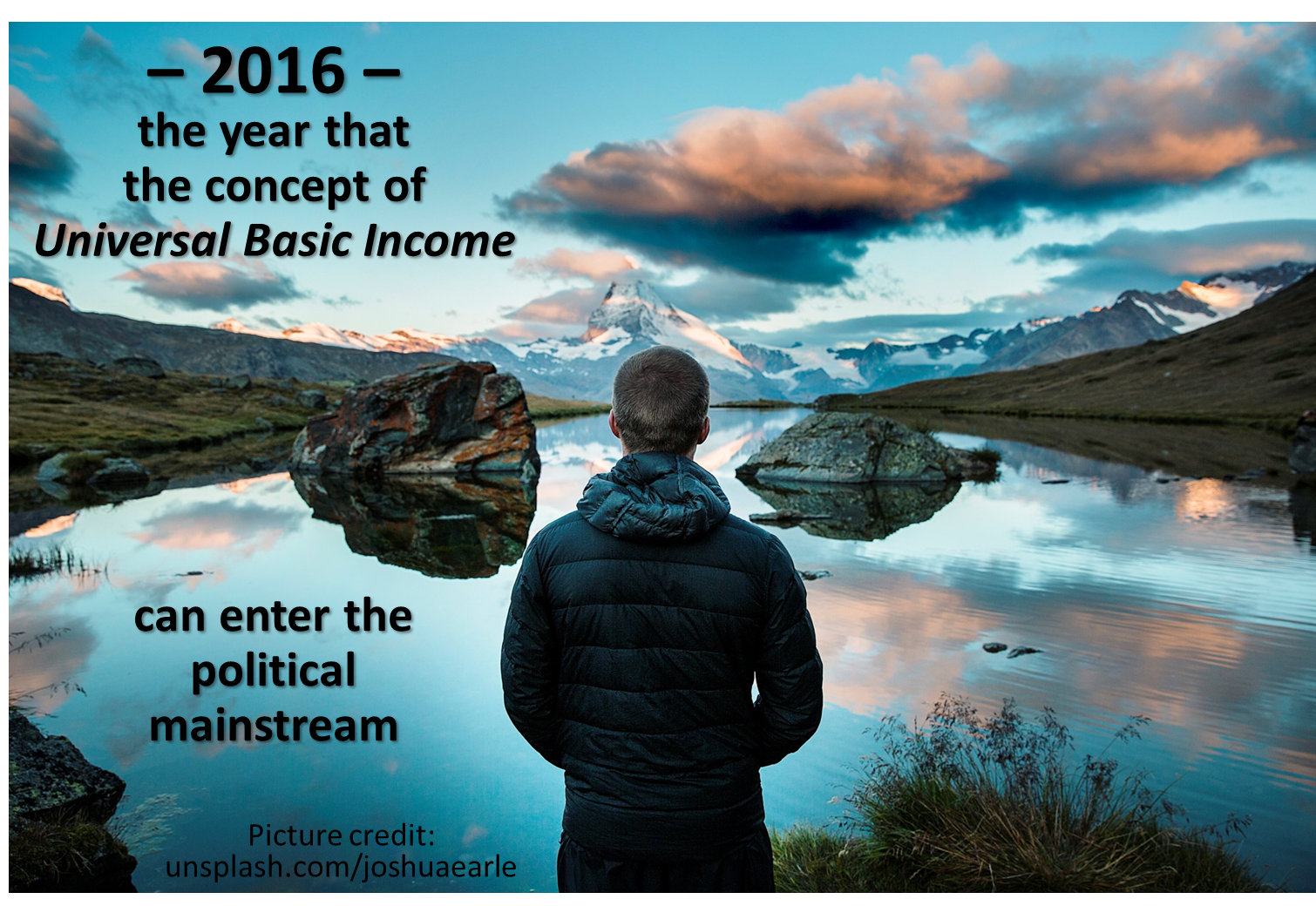
2016: the year UBI can enter the political mainstream

2016 is the year that the concept of Universal Basic Income can enter the political mainstream.

Mainstream

Universal Basic Income (UBI) is an important streamlining and simplification of the existing benefits payment systems. But it’s a great deal more than that:

  • It’s a response to the forthcoming era of material abundance and technological unemployment
  • It’s a fundamental change in attitude
  • It states that support for the basic aspects of human life will be provided to all citizens by the overall community free of conditionality
  • It celebrates and enables numerous kinds of creativity and contribution, including throughout the voluntary sector, without requiring that recipients pursue paid employment in order to receive the UBI
  • It removes the disincentives in present welfare systems that discourage people from augmenting their community payments with incremental paid employment
  • It removes the “big brother is watching you” surveillance that treats all recipients of community payments as being suspect of cheating or shirking.

(Picture credit: the underlying photo is by Unsplash contributor Joshua Earle.)

A growing conversation

Transformational ideas such as UBI take time to mature – sometimes a long time. But 2015 saw plenty of evidence of progress in the public discussion about UBI.

In 2016, this momentum is set to grow:

  • Local trials of UBI worldwide are being arranged and progress will be reviewed
  • Key open questions are rising to the fore – questions that Transpolitica will be helping to highlight and suggest answers.

At the end of 2015, Transpolitica consultants worked with members of the Transhumanist Party (UK) to prepare a press release about UBI. An extended version of that press release can be read below. The press release was prompted by the publication in London by the RSA of a comprehensive report released on the subject of UBI.

Further reading

Transhumanist Party (UK) press release – main content

(Published version is here)

Transhumanist Party welcomes RSA support for a Universal Basic Income

Changing technological circumstances accelerate the need for changed social framework

The Transhumanist Party today welcomed the publication of the RSA’s report “Creative citizen, creative state: the principled and pragmatic case for a Universal Basic Income”.

The RSA (the Royal Society for the encouragement of Arts, Manufactures and Commerce), which was founded in London in 1754, has the stated mission “to enrich society through ideas and action”. The RSA report into UBI (Universal Basic Income) follows one year of research into the topic, and makes specific proposals for how UBI might be implemented in the UK.

The idea of UBI aligns well with the Transhumanist Party principle of “Personal freedom, social justice”:

All citizens shall have a right to sustenance, clothing, shelter, energy, healthcare, transport, education, and access to information resources. The Party also advocates that all citizens must be able to contribute to society, in their own fashion, without blemish to their dignity or sense of self worth.

According to Transhumanist Party research and analysis, accelerating technological unemployment has the potential – within the next decade – to magnify social inequality, disruption and alienation. People who trained hard for new career opportunities may discover that their employment prospects have been overtaken by increasingly sophisticated robots, AIs, software, or other automation.

Dr Amon Twyman, Party Leader, commented:

A new social contract is needed, involving strong educational and economic support for those who are left with no viable option of ‘earning a living’ due to rapid technological change. A UBI would provide an important part of this new social contract. The RSA’s advocacy of a UBI will help the task of the Transhumanist Party to bring about new political thinking in the UK that champions individual and social creativity.

The Party looks forward to accelerating public discussion of UBI:

  • Designing and supporting local trials of UBI schemes
  • Sharing insight and understanding with groups worldwide who are investigating UBI
  • Building broad support, across the traditional political spectrum, for UBI
  • Mandating that, where possible, overseas foreign aid should be made available to local citizens via direct UBI schemes rather than by government manipulation.

Press release – Supplementary analysis

The following comments provide further analysis, as replies to frequently asked questions.

Q1: Will a UBI remove people’s motivation to contribute positively to society?

Different writers express different intuitions on this question. This is an example where the Transhumanist Party principle of evidence-based policy should be applied, to adjudicate between these different opinions.

The RSA report makes the following points here:

There is evidence from Basic Income pilots in the less-developed world that it spurs entrepreneurship. In developed world pilots, it has been shown to enhance wellbeing through better education and health and these are important foundations for greater creativity. This remains a hypothesis but with enough evidence to warrant further testing.

That is why we advocate a Basic Income pilot on the lines proposed in Netherlands, Finland and Canada. This would involve a whole city or city-region adopting a Basic Income to analyse its impacts over a reasonable period of, say, five years.

If the results were positive then it could be rolled out before the five years is up.

Q2: How can the UK afford all the payments comprising a UBI?

In the medium timescales (several decades), the abundance of goods created by powerful new automation and exponential technology will be more than enough to meet the basic aspirations of every citizen. However, there remains the question of how to transition from the present economic situation to that future sustainable abundance.

The system proposed by the RSA for shorter timescales is essentially tax-neutral: the amount of taxes already collected by the government, redistributed, will basically cover the costs of all proposed payouts. This is because the initial UBI is set at minimal levels, such as £71 per week per adult. Because the scheme is tax-neutral, it is more politically tractable.

As a result of UBI, more people will in due course find work that is personally pleasing and satisfying to them, without having to rush to accept the first available employment. In turn, due to increased work satisfaction, the productivity of the entire economy should rise (in both the voluntary and the paid sectors), allowing society to afford higher rates of UBI payment.

In parallel, there is scope to explore alternative ideas to distribute as “citizens’ dividends” the overall wealth of the nation – wealth derived from national assets such as 5G wireless spectrum auctions, land usage, greenhouse gas emission, and so on. These ideas are explored in books such as “With Liberty and Dividends for All: How to Save Our Middle Class When Jobs Don’t Pay Enough” by Peter Barnes, and “The Public Wealth of Nations: How Management of Public Assets Can Boost or Bust Economic Growth” by  Dag Detter and Stefan Fölster. The combination of citizens’ dividends and the initial UBI can be expected to grow in total over time, eventually resulting in a UAI (Universal Abundant Income) rather than a UBI (Universal Basic Income).

Is the Transhumanist-Technoprogressive Distinction Meaningful in Political Debate?

In this article, guest contributor Gareth John argues that the “Transhumanist Party” might fare better under the alternative name “Technoprogressive Party”.

Throwing two-pennerth into the ring

I usually start my articles with some sort of self-deprecating disclaimer as to my lack of scientific or technological credentials. Well here’s another to add to the list: I’m no politician.

Indeed I have as much understanding of political discourse as I do about quantum mechanics, which seems to have something to do with incorrect usage of my electrical toothbrush coupled with the disappearance of one of my socks and the sudden appearance of a cat means I might very well inadvertently create a black hole in my bathroom. That is, not much at all.

Nonetheless I am a paid-up member of the Transhumanist Party UK (TPUK) and proud to be so. I was a little late to the party (pun intended) so missed much of the initial decision making process and policy enumerations, logo adoption etc. I’ll admit I remain somewhat on the fence as to whether the time is right or productive to introduce the radical ideas and aims of transhumanism to the general public, but I am fully committed to to do what I can to help further the cause.

Let’s be clear from the outset: I have no desire (nor luckily the clout) to stir up schism or division that detracts from TPUK’s stated goals, but I have spent some time considering my own political stance along with my technoprogressive ideals and would like to throw my two-pennerth into the ring as to my thoughts with regard to TPUK’s political presentation.

Supporting the three broad policy statements

First off, I should commend the Party’s introduction to transhumanist principles via the upfront pitch they make on the Party website homepage. The three broad policy statement demonstrate a perspective fully in line with my own viewpoint as to what are the most critically important points to advocate.

For those who haven’t looked at the party website (http://www.transhumanistparty.org.uk) the three policies listed are:

  1. Evidence, Science and Technology.
  2. Bright Green.
  3. Personal Freedom, Social Justice.

A video on the party website from the British Institute of Posthuman Studies adds a nice touch, although does to an extent exacerbate the issue I have with with the Party’s debut, namely that of the terminology used to frame the debate. (Transhuman? Posthuman?…)

In particular, I am most concerned with the demarcation of the terms ‘transhumanism’ and ‘technoprogressivism’ and whether that should matter to those of us moving forward in the sphere of political discourse and indeed, that of the ordinary voter.

A choice of name, a choice of direction

Technojanus.png

Let me nail my colours to the mast. I identify myself as a technoprogressive. I try to use the term as much possible when writing about ‘transhuman’ issues (already the problem is apparent). I wish that IEET Director James Hughes’ attempt at popularising the term ‘technoprogressive’ had been more successful.

For me the marriage between scientific and emerging technologies together with strong ethical and social principles is critical. I want a just distribution of the costs, risks and, most importantly, benefits of this new knowledge and capacities such that they do not remain the province of the rich and dangerous alone.

From Wikipedia:

‘… for most techno-progressive critics and advocates, the achievement of better democracy, greater fairness, less violence, and a wider rights culture are all desirable, but inadequate in themselves to confront the quandaries of of contemporary technological societies unless and until they are accompanied by progress in science and technology to support and implement these aims.’

Hear, hear, say I. I am a strong supporter of progress in science and technology. And it’s apparent that precisely these self-same values are shared by TPUK given the aforementioned introduction on their website.

To be clear, I’m not writing this to debate the similarities and differences between those who choose to identify as transhumanist or technoprogressive or both or neither. That would be fruitless; within both camps there are many and varied ideologies and political leanings that are either in agreement with each other or not. My argument is that it does appear that TPUK sits very much at the technoprogressive end of the spectrum and it’s here that I’d like to set forth my stall, so to speak, in that I believe terminology matters.

Accordingly, I’m not entirely convinced that TPUK as a political party has chosen the right name for itself.

I believe there is a core difference between the terms transhumanism and technoprogressive that makes a huge difference to how people view each. The latter seems to me to describe something that is concrete: the embrace of emerging technologies together with social justice and opportunity. I’m not sure this is the case with the former, which owns to a far greater and broader range of aims and ideals and – crucially – politically so.

As a simple example, James Hughes and Zoltan Istvan are both transhumanists, but I’d bet my bottom dollar you’d only describe one of them as technoprogressive in his political stance.

Beyond preaching to the converted

All of this would be academic were it not for the fact that TPUK is a radical political party that needs to spread the word in ways that ordinary people can understand. We’re not simply going to preach to the converted and spend our time debating among ourselves and other technologically-minded individuals or those with the ready cash to consider life extension etc as soon as it’s up and running.

The problem for me is that being a transhumanist can mean many things across very broad political spectrums.

While there’s an argument to be made for diversity being a positive thing, canvassing voters is made that much more difficult when there appears to be no central core to the view we’re espousing. Is the transhumanist libertarian, liberal, small ‘c’ conservative, green, socialist, anarchist? What is it about transhumanism that appeals to them in particular and what will they prioritise as a consequence when out on the street?

I suppose you could make an argument that the same applies to a technoprogressive, but I think it’s that much more difficult to sustain this view in light of the fact that this person has already to a far greater extent identified their political aims and ideals by mere fact of identifying as a technoprogressive. As it states on the homepage of TPUK, ‘Anyone who agrees with [the Transhumanist Party Principles] and who is legally eligible to join a UK political party can do so.’ It’s clear and up-front where you stand on the major issues right from the get-go.

The need for a central political premise

It’s going to be a hard sell however you look at it, but I think it’s going to be much more difficult as ‘transhumanists’ where, when questioned about it would almost have to start with the details and work backwards. By this I mean take what’s important to them and rationalise it to fit their current agenda. A broad range of views across the political spectrum is healthy – difference of opinion and debate yes – but a political party without a central political premise is not so much a political party as it is a group of utterly diverse political opinions glued together only by their vision of the future (and even these will vary widely).

So, given the three founding principles of TPUK appear to lead one to inexorably define them as ‘technoprogressive’ in their ideals, why not define it as such? Technoprogressive Party UK sounds so much more inviting, let alone clear, to my ears than the current monicker.

A straw poll

A quick straw poll among friends and acquaintances resulted in them grasping the technoprogressive angle much more quickly and easier than transhumanism.

Transhumanism seems almost to frighten people with visions of being ‘beyond human’ – the uninitiated seemed to envision little more than lab coats, Skynet and grainy images of eugenic experimentation. The alternative, however, was far more easily understood and seemed less scary – it led to discussion whereas the former was more likely to lead to dismissal. It particularly appealed to left-of-centre participants in my little study and flashed up huge warning lights to those further to the right and also some Greens (who admittedly have their own reservations about emerging tech for specific reasons of their own).

Now this was by no means an Ipsos MORI poll as I don’t have many friends or acquaintances, but all but one said that the term technoprogressivism expressed its viewpoint clearly from the outset whereas transhumanism required a little explanation which quickly led to sci-fi scenarios and glazed eyes. Incidentally, many of them thought the TPUK logo was a little scary too, a point on which I have to agree.

th party logo

In conclusion, I’m not suggesting that things should change. Lines have already been drawn in the sand and our attention should now focus on being the best that we can be in order that the Party can be the best that it can be: best at advocating positive social change through emerging technologies. To improve ourselves and societies using the most effective tools available to us – to go beyond what we have been in order to overcome the world’s most pressing problems and create a better future.

You know… kind of like what a technoprogressive would do.

Gareth JohnAbout the author

Gareth John is a technoprogressive transhumanist fascinated by how people perceive, interpret, respond, and interact in an increasingly media rich world. His interests include ethics and emerging technologies, artificial intelligence, personality types in cyberspace, biotechnology, cognitive science, cultural posthumanism in the humanities and arts. He lives with bipolar disorder. 

Transpolitica projects update, July 2015

Transpolitica chapters being re-published by IEET

The IEET – the Institute for Ethics and Emerging Technologies – are selectively re-publishing chapters from the recent Transpolitica book Envisioning Politics 2.0 on their website http://ieet.org/.

IEET readers have already posted some interesting comments in response to these chapters. By all means take a look and, if any of the comments prompt thoughts in your mind, get involved in the discussions there.

Related: if you want to share your appreciation of Envisioning Politics 2.0 with the wider book-reading public, please consider writing a brief review on the Amazon website. Positive reviews boost sales and, in turn, boost readership of the ideas in the book.

Transpolitica involvement in H+Pedia

H+Pedia is a new wiki with the stated goal to

Spread accurate, accessible, non-sensationalistic information about transhumanism among the general public.

The H+Pedia project is currently at a very early stage but an initial content architecture has been put in place. This includes

Transpolitica supporters are invited to become involved in the H+Pedia project. In more detail, you might do one or more of the following:

  • Review some of the existing content on the site
  • Create an H+Pedia account for yourself, which will allow you to start editing pages, create new ones, and to make comments on the Talk pages
  • Update existing articles, or create new ones, according to your own areas of knowledge
  • Work step-by-step towards the creation, as part of H+Pedia, of a curated resource library of material that supports Transpolitica policies.

You can find some guidelines here about writing for H+Pedia.

To learn more about formatting and layout of H+Pedia articles, press the Edit button near the top right of any page, and inspect the sources before discarding any change. (Note that editing of the main page is restricted to users with Admin rights.) See also the documentation about MediaWiki listed at the foot of the main page of H+Pedia.

hpluspediaIn addition to improving the content, Transpolitica supporters are invited to improve the visual design of the site, including providing a better logo (the one shown above is an interim placeholder).

Two new research papers being written

Interested in the longevity dividend? Then consider becoming involved in the project to write a research paper “The case for the longevity dividend”. That paper currently starts as follows:

This document highlights the importance of the concept of the “longevity dividend”, argues that politicians of all parties should be supporting projects that will accelerate this dividend, and makes a number of specific recommendations for political action.

Interested in the concept of universal basic income? Then consider becoming involved in the project to write a research paper “Roadmap to Universal Basic Income”. That paper currently starts as follows:

This document outlines a series of steps that could be taken, worldwide, towards the realisation of a UBI (Universal Basic Income) of sufficient level to provide the foundation for a “universal prosperity”. The document considers obstacles to these steps, and makes a number of specific recommendations for political action.

In each case, the document contains pointers to where further discussion can take place about progress with the writing process.

Four political futures: which will you choose?

By David W. Wood, Executive Director, Transpolitica

Forget left wing versus right wing. The political debate in the medium-term future (10-20 years) will be dominated, instead, by a new set of arguments. These arguments debate the best set of responses to the challenges and opportunities posed by fast-changing technology.

In this essay, I’ll outline four positions: technosceptical, technoconservative, technolibertarian, and technoprogressive. I’ll argue that the first two are non-starters, and I’ll explain why I personally favour the technoprogressive stance over the technolibertarian one.

Accelerating technology

Accelerating technology

The defining characteristic of the next 10-20 years is the potential ongoing acceleration of technology. Technological development has the potential to progress even more quickly – and to have even larger effects on huge areas of life – than has been the case in the last remarkable 10-20 years.

I share the view expressed by renowned physicist Freeman Dyson, in the book “Infinite in all directions”[i] from his 1985 Gifford lectures:

Technology is… the mother of civilizations, of arts, and of sciences

Technology has given rise to enormous progress in civilization, arts and sciences over recent centuries. New technology is poised to have even bigger impacts on civilization in the next 10-20 years.

MIT professor Andrew McAfee takes up the same theme, in an article published in October last year[ii]: (emphases added)

History teaches us that nothing changes the world like technology

McAfee spells out a “before” and “after” analysis. Here’s the “before”:

For thousands of years, until the middle of the 18th century, there were only glacial rates of population growth, economic expansion, and social development.

And the “after”:

Then an industrial revolution happened, centred around James Watt’s improved steam engine, and humanity’s trajectory bent sharply and permanently upward.

One further quote from McAfee’s article rams home the conclusion:

Great wars and empires, despots and democrats, the insights of science and the revelations of religion – none of them transformed lives and civilizations as much as a few practical inventions.

In principle, many of the grave challenges facing society over the next 10-20 years could be solved by “a few practical inventions”:

  • Students complain, with some justification, about the costs of attending university. But technology can enable better MOOCs – Massive Online Open Courses – that can deliver high quality lectures, removing significant parts of the ongoing costs of running universities; free access to such courses can do a lot to help everyone re-skill, as new occupational challenges arise
  • With one million people losing their lives to traffic accidents worldwide every year, mainly caused by human driver error[iii], we should welcome the accelerated introduction of self-driving cars
  • Medical costs could be reduced by greater application of the principles of preventive maintenance (“a stitch in time saves nine”), particularly through rejuvenation biotechnology[iv] and healthier diets
  • A sustained green tech new deal should push society away from dependency on fuels that emit dangerous amounts of greenhouse gases, resulting in lifestyles that are positive for the environment as well as positive for humanity
  • The growing costs of governmental bureaucracy itself could be reduced by whole-heartedly embracing improved information technology and lean automation.

Society has already seen remarkable changes in the last 10-20 years as a result of rapid progress in fields such as electronics, computers, digitisation, and automation. In each case, the description “revolution” is appropriate. But even these revolutions pale in significance to the changes that will, potentially, arise in the next 10-20 years from extraordinary developments in healthcare, brain sciences, atomically precise manufacturing, 3D printing, distributed production of renewable energy, artificial intelligence (AI), and improved knowledge management.

Benefits to individuals but threats to society

The potential outputs from accelerating technology can usefully be split into two categories.

Enhanced humans

The first of these categories is “enhancing humans”. New technologies can provide individual humans with:

  • Extra intelligence
  • Extra health
  • Extra longevity
  • Extra material goods
  • Extra experiences
  • Extra opportunities.

The second category is “disturbing humanity”. This looks, instead, at the drawbacks from new technologies:

  • More power placed into the hands of terrorists, criminals, fanatics, and other ne’er-do-wells, to inflict chaos and damage on the rest of us
  • More power placed into the hands of governments, and the hands of corporations, to monitor us, and keep track of our every action
  • Risks from over-consumption and from the waste products of our lifestyles – including risks to planetary climate stability from excess emissions of greenhouse gases
  • Risks of technological unemployment, as growing numbers of people find themselves displaced from the job market by increasingly capable automation (robots, software, and AI)
  • So-called “existential risks”, from unintended side-effects of experiments with disease strains, genetic engineering, nanotechnology, or artificial general intelligence.

The content of both categories are extremely weighty. How should politicians react?

The technosceptical response

One response is to deny that technology will have anything like the magnitude of impact that I have just described. This technosceptical response accepts that there has been rapid change over the last 10-20 years, but also observes the following:

  • There have been other times of rapid change in the past – as when electrification was introduced, or when railways quickly criss-crossed the world; there is nothing fundamentally different about the present age
  • Past inventions such as the washing machine arguably improved lives (especially women’s lives) at least as much as modern inventions such as smartphones
  • Although there have been many changes in ICT (information and communications technology) in the last 10-20 years, other areas of technology have slowed down in their progress; for example, commercial jet airliners don’t fly any faster than in the past (indeed they fly a lot slower than Concorde)
  • Past expectations of remarkable progress in fields such as flying cars, and manned colonies on Mars, have failed to be fulfilled
  • It may well be that the majority of the “low hanging fruit” of technological development has been picked, leaving much slower progress ahead.

Kevin Kelly, the co-founder and former executive editor of Wired, had this to say about progress, in an interview in March 2014[v]:

If we were sent back with a time machine, even 20 years, and reported to people what we have right now and describe what we were going to get in this device in our pocket—we’d have this free encyclopaedia, and we’d have street maps to most of the cities of the world, and we’d have box scores in real time and stock quotes and weather reports, PDFs for every manual in the world—we’d make this very, very, very long list of things that we would say we would have and we get on this device in our pocket, and then we would tell them that most of this content was free. You would simply be declared insane. They would say there is no economic model to make this. What is the economics of this? It doesn’t make any sense, and it seems far-fetched and nearly impossible.

In other words, the last twenty years have, indeed, been remarkable – with progress that would appear “insane” to people from the beginning of that time period. But Kelly then mentions a view that is sceptical about future progress:

There’s a sense that all the big things have happened.

So many big things have happened in the last twenty years. Is there anything left to accomplish? Can science and technology really keep up the same frenetic pace?

Kelly’s answer: We’re by no means at the end of the set of major technological changes. We’re not even at the beginning of these changes:

We’re just at the beginning of the beginning of all these kind of changes.

And for a comparison of what will happen next, to what has happened in the recent past, Kelly predicts that

The next twenty years are going to make this last twenty years just pale.

I share that assessment. I base my views upon the positive feedback cycles which are in place:

  • Technology magnifies our knowledge and intelligence, which in turn magnifies our technology
  • Technology improves everyone’s ability to access cutting-edge information, via free online encyclopaedias, massive open online courses, and open source software
  • Critically, this information is available to vast numbers of bright students, entrepreneurs, hackers, and activists, throughout the emerging world as well as in countries with longer-established modern economies
  • Technology improves the ability for smart networking of prospective partners – people in one corner of cyberspace can easily improve and extend ideas that arose elsewhere
  • The set of pre-existing component solutions keeps accumulating through its own positive feedback cycles, serving as the basis for yet another round of technological breakthrough.

What’s more, insight, tools, and techniques from one technology area can quickly transfer (often in innovative ways) into new technology areas. This kind of crossover features in what is called “NBIC convergence”:
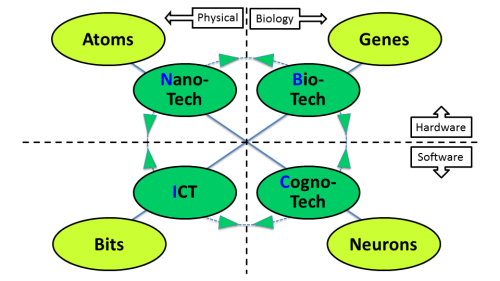
NBIC

  • The ‘I’ of NBIC is for Information and Communications Technology. It means our ability to store, transmit, and calculate bits of information. It means the transformation of music and videos and newspapers and maps into digital form, which huge impacts for industry.
  • The ‘N’ of NBIC is for Nanotechnology. It means our ability to manipulate matter at the atomic level. Nano is one thousand times smaller than Micro, which in turn is one thousand times smaller than Milli. Nanotech enables better and better 3D printing, which is poised to disrupt many industries. It also enables new kinds of material that can be super-light and super-strong, and super-flexible, such as graphene and nanotubes. These new materials will also allow the creation of human-like robots.
  • The ‘B’ in NBIC is for Biotechnology. It means our ability to create, not just new kinds of material, but new kinds of life. It means our ability to reprogram, not just the silicon inside transistors, but the long chains of carbon-based DNA inside our cells. We’ll be applying software techniques to re-engineer genes. We’ll be able, if we wish, not just to create so-called “designer babies”, but also “re-designed adults”. With nano-sized computers, sometimes called nanobots, doctors will be able to target very precisely any ailing parts of our body, including cancerous cells, or tangles in the brain, and fix them. And, if we want, we’ll be able to remain perpetually youthful, with nano cosmetic surgery, both outside and inside the body.
  • And the ‘C’ in NBIC is for Cognotechnology. It means our ability to understand and improve the basis of cognition – thought and feeling. With very powerful scanners we can understand more precisely what’s going on inside our brains. And we can engineer new moods, new creativity, and (if we wish) new states of ecstasy and bliss.

The real significance of NBIC isn’t just in the four individual areas. It’s in the crossovers between the four fields:

  • Nano-sensors allow closer study than ever before of what is happening in the brain
  • Insight on how the brain performs its near-miracles of cognition will feed back into new algorithms used in next generation AI
  • Improved AI allows systems such as IBM Watson to study vast amounts of medical literature, and then make new suggestions about treating various diseases, etc.

For these reasons, I discount the technosceptical answer. It’s very unlikely that technological progress will run out of steam. However, I am sympathetic in two aspects to the technosceptical position.

First, I don’t see the detailed outcome of technological development as in any way inevitable. The progress that will be made will depend, critically, upon public mood, political intervention, the legislative framework, and so on. It will also depend on the actions of individuals, which can be magnified (via the butterfly effect) to have huge impacts. Specifically, all these factors can alter the timing of various anticipated product breakthroughs.

Second, I do see one way in which the engines of technological progress will become unstuck. That is if society enters a new dark age, via some kind of collapse. This could happen as a result of the influences I listed earlier as “technology disturbing humanity, threatening society”. If technologists ignore these threats, they could well regret what happens next. Plans for improved personal intelligence, health, longevity, etc, could suddenly be undercut by sweeping societal or climatic changes.

That leads me to the second of the four responses that I wish to discuss.

The technoconservative response

Whereas technosceptics say, in effect, “there’s no need to get worked up about the impact of technological change, since that change is going to slow down of its own accord”, technoconservatives say “we need to slow that change down, since otherwise bad things are going to happen – very bad things”.

Technoconservatives take seriously the linkage between ongoing technological change and the threats to society and humanity that I listed earlier. Unless that engine of change is brought under serious control, they say, technology is going to inflict terrible damage on the planet.

For example, many metrics for the health of the environment are near danger points, as a result of human lifestyles that are fuelled by conspicuous consumption. There are major shortages of fresh water. Species are becoming extinct at an unprecedented rate. Some of the accidents that are waiting to happen would make the Fukushima disaster site look like a mild hiccup in comparison. We may be close to a tipping point in global climate, which would trigger the wrong kind of positive feedback cycle (a cycle of increasing warmth). We may also be close to outbreaks of unstoppable pathogens, spread too quickly around the world by criss-crossing jet travellers rushing from one experience to another.

Enough

Technoconservatives want to cry out, “Enough!” They want to find ways to apply the brake on our technological steamroller – or (to change the metaphor) to rip out the power cable that keeps the engine of technological progress humming. Where technologists keep putting more opportunities into people’s hands – opportunities to remake what it means to be human – technoconservatives argue for a period of prolonged reflection. “Let’s not play God”, some of them might say. “Let’s be very careful not to let the genie out of the bottle.”

They’ll argue that technology risks leading people astray. Instead of us applying straightforward, ordinary, common-sense solutions to social problems, we’re being beguiled by faux techno-solutions. Instead of authentic, person-to-person relations, we’re spending too much time in front of computer screens, talking to virtual others, neglecting our real-world neighbours. Instead of discovering joy in what’s natural, we’re losing our true nature in quests for technotopia. These quests, argue the technoconservatives, aren’t just misguided. They’re deeply dangerous. We might gain a whole universe of electronic and chemical satiation, but we’ll lose our souls in the process. And not only our souls, but also our lives, if some of the existential risks come to fruition.

But whenever a technoconservative says that technology has already developed enough, and there’s no need for it to continue any further, I’ll point out the vicious impediments that still blight people’s lives the world over – disease, squalor, poverty, ignorance, oppression, aging. It’s true; some of these obstacles could be tackled by non-technological means, such as by politics or social change. But the solutions to other issues lie within the grasp of further scientific and technological progress. Think of the terrible pain still inflicted by numerous diseases, both in young people and in the elderly. Think of the heartache caused by neurodegeneration and dementia. Rejuvenation biotechnology has the latent ability to make all these miseries as much a thing of the past as deaths from tuberculosis, smallpox, typhoid, or the bubonic plague. Anyone who wants to block this progress by proclaiming “Enough” has a great deal of explaining to do.

In any case, is the technoconservative programme feasible? Could the rate of pace of technological change really be significantly slowed down?

Any such action is going to require large-scale globally coordinated agreements. It’s not sufficient for any one company to agree to avoid particular lines of product development. It’s not sufficient for any one country to ban particular fields of technological research. Everyone would need to be brought to the same conclusion, the world over. And everyone would need to be confident that everyone else is going to honour agreements to abstain from various developments.

The problem is, however, that the technology engine is delivering huge numbers of good outputs, in parallel with its bad outputs. And too many people (especially powerful people) are benefiting – or perceive themselves to be benefiting – from these outputs.

Compare the technoconservative thought with the idea that we could switch off the Internet. That would have the outcome of stopping various undesirable activities that currently take place via the Internet – abusive trolling, child pornography, distribution of dangerously substandard counterfeit goods, incitement by fanatical terrorists for impressionable youngsters to join their cause, and so on. But any such mass switch off would also stop all of the other systems which coexist on the Internet with the abovementioned nefarious examples, using the same communications protocols. Systems for commerce, finance, newsflow, entertainment, travel booking, healthcare, social networking, and so on, would all crash to a halt. For good or for ill, we’ve become deeply dependent on these systems. We’re very unlikely to agree to do without them.

Separate from the question of the desirability of shutting down the entire Internet is the question of the feasibility of doing so. After all, the Internet was designed with robustness in mind, including multiple redundancies. Supposedly, it will survive the outbreak of a (minor) nuclear war.

These same two objections – regarding desirability, and regarding feasibility – undermine any thought that the entirety of technological progress could be stopped. The technoconservative approach is too blunt, and is bound to fail.

But while we cannot imagine voluntarily dismantling that great engine of progress, what we can – and should – imagine is to guide that engine more powerfully. Instead of seeking to stop it, we can seek to shape it. That’s the approach favoured by technoprogressives. We’ll come to that shortly.

The technolibertarian response

The technolibertarian view is a near direct opposite of the technoconservative one. Whereas the technoconservatives say “stop – this is going too fast”, technolibertarians say “go faster”.

It’s not that technolibertarians are blind to the threats which cause so much concern to the technoconservatives. On the whole, they’re well aware of these threats. However, they believe that technology, given a free hand, will solve these problems. Technoconservatives, in this analysis, are becoming unnecessarily anxious.

For example, excess greenhouse gases may well be sucked out of the atmosphere by clever carbon capture systems, perhaps involving specially engineered bio-organisms. In any case, green energy sources – potentially including solar, geothermal, biofuels, and nuclear – will soon become cheaper than (and therefore fully preferable to) carbon-based fuels. As for problems with weaponry falling into the wrong hands, suitable defence technology could be created. Declines in biodiversity could be countered by Jurassic Park style technology for species resurrection. Ample fresh water can be generated by desalination processes from sea water, with the energy to achieve this transformation being obtained from the sun. And so on.

Singularity University Logo Blend Text White

This viewpoint has considerable support throughout parts of Silicon Valley, and also finds strong representation in the faculty of Singularity University. Peter Diamandis, co-founder of Singularity University, offers this advice, in a 2014 Forbes article entitled “Turning Big Problems Into Big Business Opportunities”[vi]:

Want to become a billionaire? Then help a billion people.

The world’s biggest problems are the world’s biggest business opportunities.

That’s the premise for companies launching out of Singularity University (SU).

Allow me to explain.

In 2008, Ray Kurzweil and I co-founded SU to enable brilliant graduate students to work on solving humanity’s grand challenges using exponential technologies.

This week we graduated our sixth Graduate Studies Program (GSP) class.

During the GSP, we ask our students to build a company that positively impacts the lives of 1 billion people within 10 years.

Tellingly, Diamandis’ latest book[vii] has the title “Bold”. It’s not called “Go slow”. Nor “Be careful”.

To my mind, there’s a lot to admire in these sentiments. I share the view that technology can provide tools that can allow the solution of the social problems described.

Where things become more contentious, however, is in the attitude of technolibertarians towards the role of government. The main request of technolibertarians to politicians is “hands off”. They want government to provide a free rein to smart scientists, hard-working technologists, and innovative entrepreneurs – a free rein to pursue their ideas for new products. It is these forces, they say, which will produce the solutions to society’s current problems.

Technolibertarians echo the sentiment of Ronald Reagan[viii] that the nine most terrifying words in the English language are, “I’m from the government and I’m here to help.” Governments suffer, in this view, from a number of deep-rooted problems:

  • Politicians seek to build empires
  • Politicians have little understanding of the latest technologies
  • Politicians generally impose outdated regulations – which are concerned with yesterday’s problems rather than with tomorrow’s opportunities
  • Regulators are liable to “capture” – an over-influence from vested interests
  • Politicians have no ability to pick winners
  • Political spending builds a momentum of its own, behind “white elephant” projects.

The technolibertarian recipe to solve social problems, therefore, is technology plus innovation plus free markets, minus intrusive regulations, and minus government interference. The role of government should be minimised – perhaps even privatised.

The technolibertarian spectrum

So far, I’ve given a charitable account of the motivation of technolibertarians. They’re aware of major risks to social well-being, I’ve said. And they want to apply technology to fix these problems.

There’s also a less charitable account, which I’ll mention, since it probably does describe a subset of technolibertarians. That subset has a somewhat different motivation. They don’t particularly care for the well-being of all humanity; rather, they focus on their own well-being. In some cases, they’re prepared to risk the destruction of large swathes of humanity – perhaps even the entirety of humanity. They embrace that risk, because they believe the only way for technological progress to proceed as quickly as possible is to play fast and loose with these risks. For them, the upside of technology achieving its potential is more important than the risk of major collateral damage. They want the possibility of the upside of exponential technology, for themselves, much more than they worry about any downsides of using that technology. In parallel, they’re motivated to find evidence that various existential risks are much less serious than commonly supposed.

Accordingly, there’s a spectrum within the technolibertarian camp of people who hold different motivations to different extents. It may be significant that the full title of the abovementioned recent book by Peter Diamandis[ix] – “Bold: How to Go Big, Create Wealth and Impact the World” – puts “create wealth” ahead of “impact the world”, as if the latter is a kind of afterthought. The personal success of “going big” has an even higher priority.

Bold Cover

A good indication of the range of technolibertarian stances is found in the introductory text of the well-run “Technolibertarians” group on Facebook[x]. It starts as follows:

Technolibertarians is a group of individuals committed to:

  • The idea of fostering private governments (often referred to Anarcho-Capitalism), or much smaller forms of the present forms of governments (often referred to as Classical Liberalism and/or Minarchism), both of which support greatly increased amounts of individual freedom in the personal and economic spheres both in and out of the worlds of the Internet;
  • Support for increasing the speed of the development of life extending and human-improving technologies, known as Transhumanism (H+), and the same as it regards creation of Strong Artificial Intelligence (also known as Artificial General Intelligence), until the point of reaching the Technological Singularity.

The Technological Singularity is the name given to the envisaged future point when artificial intelligence (AI) is more intelligent, in all relevant dimensions, than humans. The resulting AI is expected to be capable of solving all remaining human problems at that time, for example finding cures to any diseases that remain unsolved. Technolibertarians tend to take it for granted that such an AI will comply with human desires to find such cures, rather than adopting a different worldview in which slow-witted small-minded divisive humankind is seen as an irrelevance or a pest. That’s in line with the general technolibertarian tendency to minimise the potential downsides of fast-changing technology.

The group’s intro continues as follows:

Specifically, we wish to ensure that as technologies in these fields enhance and increase the rate of human evolution without being instruments of oppression, but rather, instruments of freedom for the individual to pursue his or her dreams in whichever manner the best deem fit, and, that these common goals can best be achieved by keeping markets and individuals as unencumbered by governments as possible, for as long as possible, until the Technological Singularity is reached.

The final paragraph of the intro has one point worth noting. That section lists the set of topics which the group asks to be excluded from its discussions:

NOTE: Proponents of things like anti-GMO/anti-vaccine luddism, chemtrailers, 9/11 truthers, Zeitgeist/Venus Project, and Raelianism, Climate alarmism, and other pseudoscientific beliefs are unwelcome to promote their unscientific irrational moonbattery in this group. Avoid logical fallacies, stick to facts.

The inclusion of “Climate alarmism” in this list of “pseudoscientific beliefs” and “unscientific moonbattery” is a reminder of the technolibertarian opposition to any focus on the potential drawbacks of misuse of technology. In that view, there’s no need to stir up any alarm about the potential for rapid climate change. Instead, provided politicians and regulators are kept out of the way, technologists and entrepreneurs will ensure that the climate remains hospitable.

The technoprogressive response

Technoprogressives share with technolibertarians the core proposition sometimes called “the central meme of transhumanism”[xi] – that it is that it is ethical and desirable to improve the human condition through technology. Both positions see very important positive roles for science and technology, and also for the productive energies that can be unleashed by entrepreneurs, start-ups, and other business groupings. The difference between the positions is in the question of whether political and legislative intervention can have positive outcomes. Both groups are aware that, in practice, political and legislative intervention is often cumbersome, self-serving, misguided, and unnecessarily hinders the speedy development of innovative products. The groups differ in whether it’s worth seeking better politics and better legislation.

The central meme of social futurism[xii] (which is a kind of synonym for the technoprogressive standpoint) states, analogously to the central meme of transhumanism, that it is ethical and desirable to improve society through technology. Technology isn’t just restricted to improving the human body and mind – doing better than Darwinian natural selection. It’s capable of improving human politics and human economics – doing better than the invisible hand of free markets. (Though, in both cases, modifications need to be approached with care.)

Some phrases from the Technoprogressive Declaration[xiii] – created in November 2014 – highlight the distinctive position taken by technoprogressives:

The world is unacceptably unequal and dangerous. Emerging technologies could make things dramatically better or worse. Unfortunately too few people yet understand the dimensions of both the threats and rewards that humanity faces. It is time for technoprogressives, transhumanists and futurists to step up our political engagement and attempt to influence the course of events.

Our core commitment is that both technological progress and democracy are required for the ongoing emancipation of humanity from its constraints…

We must intervene to insist that technologies are well-regulated and made universally accessible in strong and just societies. Technology could exacerbate inequality and catastrophic risks in the coming decades, or especially if democratized and well-regulated, ensure longer, healthy and more enabled lives for growing numbers of people, and a stronger and more secure civilization…

As artificial intelligence, robotics and other technologies increasingly destroy more jobs than they create, and senior citizens live longer, we must join in calling for a radical reform of the economic system. All persons should be liberated from the necessity of the toil of work. Every human being should be guaranteed an income, healthcare, and life-long access to education.

Evidently, this Declaration aims at liberation – similar to the technolibertarian stance. But the methods in the Declaration listed include

  • Radical reform of the economic system
  • Smart regulation of new technologies
  • The democratisation of access to new technologies
  • Stepping up political engagement.

Another distinctive aspect of the Technoprogressive Declaration is in its recurring references to inequality. Indeed, the very first phrase is “The world is unacceptably unequal”. The picture accompanying the Declaration on the IEET website carries the word “egalitarianism” – the principle that all people deserve equal rights and opportunities.
technoprogressive_declaration_2014

To sharpen our understanding of the differences between technolibertarians and technoprogressives, let’s look more closely at this question of inequality – a topic which is strikingly missing from the introductory definition on the Facebook “Technolibertarians” group.

Growing inequality
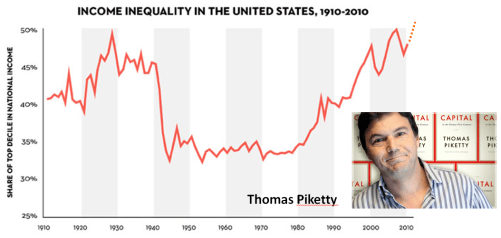
Piketty

Publications[xiv] over the last few years by researchers such as Thomas Piketty[xv] and Emmanuel Saez[xvi] make it undeniable that, in many countries, including the US and the UK, the share of income being received by upper fractions of the population is rising to levels unprecedented since before the great depression of the 1930s. For example, the best paid 10% in the US now receive just over 50% of the total income in that country – up from around 35% over the 1940s, 50s, 60s, and 70s.

The Economist magazine noted in a November 2014 article[xvii], in a section headlined “The really, really rich get much, much richer”:

The fortunes of the wealthy have grown, especially at the very top. The 16,000 families making up the richest 0.01%, with an average net worth of $371m, now control 11.2% of total wealth—back to the 1916 share, which is the highest on record.

Similar trends apply throughout Western Europe (though less extreme).

Similar trends exist in Russia. Writing in October 2013, Ron Synovitz reported findings[xviii] from the annual global wealth study published by the financial services group Credit Suisse:

A new report on global wealth has determined that Russia now has the highest level of wealth inequality in the world – with the exception of a few small Caribbean nations where billionaires have taken up residency… A mere 110 Russian citizens now control 35 percent of the total household wealth across the vast country.

By comparison, billionaires worldwide account for just 1 to 2 percent of total wealth.

The report says Russia has one billionaire for every $11 billion in wealth while, across the rest of the world, there is one billionaire for every $170 billion.

Billionaire investor Warren Buffet – the admired “sage of Omaha” who has contributed large amounts of his own personal wealth to philanthropic ventures – commented drily as follows[xix]:

There’s been class warfare going on for the last 20 years, and my class has won. We’re the ones that have gotten our tax rates reduced dramatically.

If you look at the 400 highest taxpayers in the United States in 1992, the first year for figures, they averaged about $40 million of [income] per person. In [2010], they were $227 million per person… During that period, their taxes went down from 29 percent to 21 percent of income.

The raw statistics are incontrovertible. Where there’s scope for debate is in the interpretation of the figures.

Many people respond that inequality of outcome is no big deal. People are different, and that it’s right that their different efforts and talents are rewarded differently. I’ll come back in a moment to the question of the degree of the inequality of outcome, and whether that extreme is good for society. But we also need to look at the growing inequality of opportunity. The relevant dynamics were summed up evocatively in a recent perceptive speech in Washington[xx]. The speech explored the background to frustrations being expressed by US voters about the performance of their politicians. Here are some brief excerpts:

People’s… frustration is rooted in their own daily battles – to make ends meet, to pay for college, buy a home, save for retirement. It’s rooted in the nagging sense that no matter how hard they work, the deck is stacked against them. And it’s rooted in the fear that their kids won’t be better off than they were. They may not follow the constant back-and-forth in Washington or all the policy details, but they experience in a very personal way the relentless, decades-long trend that I want to spend some time talking about today. And that is a dangerous and growing inequality and lack of upward mobility that has jeopardized middle-class America’s basic bargain – that if you work hard, you have a chance to get ahead.

I believe this is the defining challenge of our time…

While we don’t promise equal outcomes, we have strived to deliver equal opportunity – the idea that success doesn’t depend on being born into wealth or privilege, it depends on effort and merit…

We’ve never begrudged success in America. We aspire to it. We admire folks who start new businesses, create jobs, and invent the products that enrich our lives. And we expect them to be rewarded handsomely for it. In fact, we’ve often accepted more income inequality than many other nations for one big reason – because we were convinced that America is a place where even if you’re born with nothing, with a little hard work you can improve your own situation over time and build something better to leave your kids…

The problem is that alongside increased inequality, we’ve seen diminished levels of upward mobility in recent years. A child born in the top 20% has about a 2-in-3 chance of staying at or near the top. A child born into the bottom 20% has a less than 1-in-20 shot at making it to the top. He’s 10 times likelier to stay where he is.

The speech was made by US President Barack Obama, and is worth reading in full[xxi], regardless of your own political leanings (Republican, Democrat, or whatever).

Responses to growing inequality

Let’s look again at the changes in tax rate experienced by the top 400 taxpayers in the US, over the period 1992 to 2010. While the average income in that group soared more than five-fold – from $40M to $227M – the tax-rate fell from 29% to 21%.

In my experience, technolibertarians have three responses to statistics of this sort. First, they sometimes assert that the people benefiting from these hugely increased incomes (and declining tax rates) uniquely deserve these benefits. The market has delivered these benefits to them, and the market is always right. Second, they may point out that the tax office is a lot better off with 21% of $227M than with 29% of $40M. Third, they say that even if the rich are seeing their wealth rise faster than before, the poor are also becoming wealthier – so we are switching from a world of “haves and have-nots” to a world of “have-a-lots and haves”. In this new world, even the poorest (if they manage their lives sensibly) can access a swathe of goods that would have been viewed in previous times as spectacular luxuries.

There’s a gist of truth in all three answers. Changing market circumstances mean that winning companies do take a larger share of rewards that in previous times. The factors behind “winner takes all” outcomes are described in, for example, the book “The Second Machine Age”[xxii] by Erik Brynjolfsson and Andrew McAfee, of MIT:

  • The digitization of more and more information, goods, and services
  • The vast improvements in telecommunications and transport – the best products can be used in every market
  • The increased importance of networks and standards – new capabilities and new ideas can be combined and recombined more quickly.

2ma

This effect is also known as “the economics of superstars”, using a term coined in 1981[xxiii] by Sherwin Rosen:

The phenomenon of Superstars, wherein relatively small numbers of people earn enormous amounts of money and dominate the activities in which they engage, seems to be increasingly important in the modern world.

This analysis explains why the photo sharing company Instagram, with only 13 employees at the time (but with 100 million registered users) was valued at $1B when acquired by Facebook in April 2012. In contrast, another company in the field of photography, Kodak, had its peak valuation of $30B in 1997, when it had 86,000 employees. This implies that Instagram employees had, on average, 2,000 times the productivity of Kodak employees. This productivity advantage was due to how Instagram took special advantage of pre-existing technology.

The analysis is continued in a landmark MIT Technology Review article by David Rotman, “Technology and inequality”[xxiv]:

The signs of the gap—really, a chasm—between the poor and the super-rich are hard to miss in Silicon Valley. On a bustling morning in downtown Palo Alto, the center of today’s technology boom, apparently homeless people and their meager belongings occupy almost every available public bench. Twenty minutes away in San Jose, the largest city in the Valley, a camp of homeless people known as the Jungle—reputed to be the largest in the country—has taken root along a creek within walking distance of Adobe’s headquarters and the gleaming, ultramodern city hall.

The homeless are the most visible signs of poverty in the region. But the numbers back up first impressions. Median income in Silicon Valley reached $94,000 in 2013, far above the national median of around $53,000. Yet an estimated 31 percent of jobs pay $16 per hour or less, below what is needed to support a family in an area with notoriously expensive housing. The poverty rate in Santa Clara County, the heart of Silicon Valley, is around 19 percent, according to calculations that factor in the high cost of living.

Even some of the area’s biggest technology boosters are appalled. “You have people begging in the street on University Avenue [Palo Alto’s main street],” says Vivek Wadhwa, a fellow at Stanford University’s Rock Center for Corporate Governance and at Singularity University, an education corporation in Moffett Field with ties to the elites in Silicon Valley. “It’s like what you see in India,” adds Wadhwa, who was born in Delhi. “Silicon Valley is a look at the future we’re creating, and it’s really disturbing.”

Rotman goes on to quote legendary venture capitalist Steve Jurvetson, Managing Director at Draper Fisher Jurvetson. Jurvetson was an early investor in Hotmail and sits on the boards of SpaceX, Synthetic Genomics, and Tesla Motors:

“It just seems so obvious to me [that] technology is accelerating the rich-poor gap,” says Steve Jurvetson… In many discussions with his peers in the high-tech community, he says, it has been “the elephant in the room, stomping around, banging off the walls.”

Just because there is strong market logic to the way in which technological superstars are able to command ever larger incomes, this does not mean, of course, that we should acquiesce in this fact. An “is” does not imply an “ought”. Even an enlightened self-interest should cause a rethink within “the 1%” (and their supporters on lower incomes – who often aspire to being to reach these stellar salary levels themselves). A plea for such a rethink[xxv] was issued by one of its members, Nick Hanauer. Hanauer introduced himself as follows:

You probably don’t know me, but like you I am one of those .01%ers, a proud and unapologetic capitalist. I have founded, co-founded and funded more than 30 companies across a range of industries—from itsy-bitsy ones like the night club I started in my 20s to giant ones like Amazon.com, for which I was the first nonfamily investor. Then I founded aQuantive, an Internet advertising company that was sold to Microsoft in 2007 for $6.4 billion. In cash. My friends and I own a bank. I tell you all this to demonstrate that in many ways I’m no different from you. Like you, I have a broad perspective on business and capitalism. And also like you, I have been rewarded obscenely for my success, with a life that the other 99.99 percent of Americans can’t even imagine. Multiple homes, my own plane, etc., etc.

But Hanauer was not writing to boast. He was writing to warn. The title of his article made that clear: “The Pitchforks Are Coming… For Us Plutocrats”. This extract conveys the flavour:

The problem isn’t that we have inequality. Some inequality is intrinsic to any high-functioning capitalist economy. The problem is that inequality is at historically high levels and getting worse every day. Our country is rapidly becoming less a capitalist society and more a feudal society. Unless our policies change dramatically, the middle class will disappear, and we will be back to late 18th-century France. Before the revolution.

And so I have a message for my fellow filthy rich, for all of us who live in our gated bubble worlds: Wake up, people. It won’t last.

If we don’t do something to fix the glaring inequities in this economy, the pitchforks are going to come for us. No society can sustain this kind of rising inequality. In fact, there is no example in human history where wealth accumulated like this and the pitchforks didn’t eventually come out. You show me a highly unequal society, and I will show you a police state. Or an uprising.

Guillotine

Declining costs

But what about the declining costs of both the necessities and the luxuries of life? Won’t the imminent material abundance, enabled by exponential technologies, remove the heartaches caused by present-day inequalities? Here, the technolibertarians have a fair point.

After all, Mary Meeker’s annual KPCB reviews of Internet trends contain some eye-popping statistics of declining costs. Here are some call-outs from her 2014 presentation[xxvi]:

  • Computational costs have declined 33% annually from 1990 to 2013: a million transistors cost $527 in 1990 but only 5 cents in 2013
  • Storage costs declined 38% annually from 1992 to 2013: a Gigabyte of storage came down in price over that time from $569 to 2 cents
  • Bandwidth costs declined 27% annually from 1999 to 2013: connectivity of 1 Gbps came down in price over that time from $1,245 to $16
  • Even smartphones, despite their ever-greater functionality, have seen their costs decline 5% annually from 2008 to 2013.

One result of that final trend – as reported in Meeker’s KPCB presentation in 2015[xxvii] – is that smartphone US market penetration jumped up from 18% in 2009 to 64% in 2014. Even in the US, with all its manifest inequalities, access to smartphones evidently extends far beyond the 1%. That access brings, in turn, the opportunity to browse much more information, 24×7, than was available even to US Presidents just a couple of decades ago.
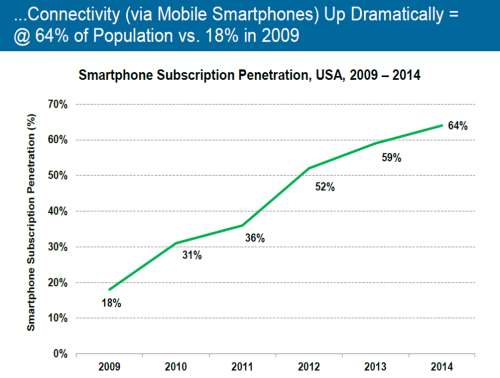
Smartphone Growth

Yuri Van Geest of the Singularity University picks up the analysis, in an attractive slideset introduction[xxviii] to his book “Exponential Organizations”.[xxix]. These slides illustrate remarkable price reductions for (broadly) like-for-like functionality in a range of fast-improving technological fields:

  • Industrial robots: 23-fold reduction in 5 years
  • Neurotech devices for brain-computer interface (BCI): 44-fold reduction in 5 years
  • Autonomous flying drones: 142-fold reduction in 6 years
  • 3D-printing: 400-fold reduction in 7 years
  • Full DNA sequencing: 10,000-fold reduction (from $10M to $1,000) in 7 years.

Similar price reductions, it can be argued, will take all the heat out of present-day unequal access to goods. In the meantime, technolibertarians urge two sets of action:

  • Let’s press forwards quickly with further technological advances
  • Let’s avoid obsessing about present-day inequalities (and, especially, the appearance of present-day inequalities), since the more they’re spoken about, the greater the likelihood of people becoming upset about them and taking drastic action.

However, at the same time as technology can reduce prices of products that have already been invented, it can result in the creation of fabulous new products. Some of these new products start off as highly expensive – especially in fields such as advanced healthcare. Sectors such as rejuvenation biotech and neuro-enhancement may well see the following outcomes:

  • Initial therapies are expensive, but deliver a decisive advantage to the people who can afford to pay for them
  • With their brains enhanced – and with their bodies made more youthful and vigorous – the “winner takes all” trend will be magnified
  • People who are unable to pay for these treatments will therefore fall even further behind
  • Social alienation and angst will grow, with potentially explosive outcomes.

A counter-argument is that enterprising companies will be motivated to quickly make products available at lower cost. Rather than pursuing revenues from small populations of wealthy consumers, they will set their eyes on the larger populations of consumers with lower incomes. But if the raw cost of the product itself remains high, that may not be easy. Apple’s policy of targeting the wealthier proportion of would-be smartphone users makes good sense in its own terms.

A similar policy – this time by pharmaceutical giant Bayer – was described in an article by Glyn Moody in early 2014[xxx]. The article carried the headline “Bayer’s CEO: We Develop Drugs For Rich Westerners, Not Poor Indians”. It quoted Bayer Chief Executive Officer Marijn Dekkers as follows:

We did not develop this medicine for Indians. We developed it for western patients who can afford it.

That policy aligns with the for-profit motivation that the company pursues, in service of the needs of its shareholders to maximise returns. But as Moody points out, pharmaceutical companies have, in the past, shown broader motivation. He refers to this quote from 1950 from George Merck[xxxi] (emphasis added):

We try never to forget that medicine is for the people. It is not for the profits. The profits follow, and if we have remembered that, they have never failed to appear. The better we have remembered it, the larger they have been…

We cannot step aside and say that we have achieved our goal by inventing a new drug or a new way by which to treat presently incurable diseases, a new way to help those who suffer from malnutrition, or the creation of ideal balanced diets on a worldwide scale. We cannot rest till the way has been found, with our help, to bring our finest achievement to everyone.

What determines whether the narrow financial incentives of the market govern behaviours of companies with the technology (possibly unique technology) that enables significant human enhancement? Other factors need to come into play – not just financial motivation.

The genius – and limits – of free markets

Even within their own parameters – the promotion of optimal trade and the accumulation of wealth – free markets often fail. The argument for smart oversight and regulation of markets is well made in the 2009 book “How markets fail: the logic of economic calamities”[xxxii] by the New Yorker journalist John Cassidy[xxxiii].

Cassidy_How_Markets_Fail

The book contains a sweeping but compelling survey of a notion Cassidy dubs “Utopian economics”, before providing layer after layer of decisive critique of that notion. As such, the book provides a very useful guide to the history of economic thinking, covering Adam Smith, Friedrich Hayek, Milton Friedman, John Maynard Keynes, Arthur Pigou, Hyman Minsky, among others.

The key theme in the book is that markets do fail from time to time, potentially in disastrous ways, and that some element of government oversight and intervention is both critical and necessary, to avoid calamity. This theme is hardly new, but many people resist it, and the book has the merit of marshalling the arguments more comprehensively than I have seen elsewhere.

As Cassidy describes it, “utopian economics” is the widespread view that the self-interest of individuals and agencies, allowed to express itself via a free market economy, will inevitably produce results that are good for the whole economy. The book starts with eight chapters that sympathetically outline the history of thinking about utopian economics. Along the way, he regularly points out instances when free market champions nevertheless described cases when government intervention and control was required. For example, referring to Adam Smith, Cassidy writes:

Smith and his successors … believed that the government had a duty to protect the public from financial swindles and speculative panics, which were both common in 18th and 19th century Britain…

To prevent a recurrence of credit busts, Smith advocated preventing banks from issuing notes to speculative lenders. “Such regulations may, no doubt, be considered as in some respects a violation of natural liberty”, he wrote. “But these exertions of the natural liberty of a few individuals, which might endanger the security of the whole society, are, and ought to be, restrained by the laws of all governments… The obligation of building party walls [between adjacent houses], in order to prevent the communication of a fire, is a violation of natural liberty, exactly of the same kind with the regulations of the banking trade which are here proposed.”

The book identifies long-time Federal Reserve chairman Alan Greenspan as one of the villains of the great financial crash of 2007-2009. Cassidy quotes a reply given by Greenspan[xxxiv] to the question “Were you wrong” asked of him in October 2008 by the US House Committee on Oversight and Government Reform:

“I made a mistake in presuming that the self-interest of organizations, specifically banks and others, were such that they were best capable of protecting their own shareholders and their equity in the firms…”

Greenspan was far from alone in his belief in the self-correcting power of economies in which self-interest is allowed to flourish. There were many reasons for people to hold that belief. It appeared to be justified both theoretically and empirically. As Greenspan remarked,

“I have been going for forty years, or more, with very considerable evidence that it was working exceptionally well.”

Cassidy devotes another eight chapters to reviewing the history of criticisms of utopian economics. This part of the book is entitled “Reality-based economics”, and covers topics such as:

  • Game theory (“the prisoners dilemma”),
  • Behavioural economics (pioneered by Daniel Kahneman and Amos Tversky) – including disaster myopia,
  • Problems of spillovers and externalities (such as pollution) – which can only be fully addressed by centralised collective action,
  • Drawbacks of hidden information and the failure of “price signalling”,
  • Loss of competiveness when monopoly conditions are approached,
  • Flaws in banking risk management policies (which drastically under-estimated the consequences of larger deviations from “business as usual”),
  • Problems with asymmetric bonus structure,
  • The perverse psychology of investment bubbles.

In summary, Cassidy lists four “illusions” of utopian economics:

  1. The illusion of harmony: that free markets always generate good outcomes;
  2. The illusion of stability: that free market economy is sturdy;
  3. The illusion of predictability: that distribution of returns can be foreseen;
  4. The illusion of Homo Economicus: that individuals are rational and act on perfect information.

These illusions remain pervasive in many parts of economic thought. These illusions also lie behind technolibertarian optimism that technology, without government intervention, will be able to solve social and climatic problems such as terrorism, surveillance, environmental devastation, and threats from new pathogens.

Indeed, free markets and innovative technology have, together, been a tremendous force for progress in recent history. However, they need smart oversight and regulation if they are going to reach their fullest potential. That thought lies at the core of the technoprogressive stance.

The political landscape ahead

The need for smart oversight and regulation will grow even more pressing, as technology progresses over the next few decades to the point of displacing ever larger numbers of people from the workforce. This scenario is described in the recent book by Martin Ford, “Rise of the Robots: Technology and the Threat of a Jobless Future”[xxxv].
Rise of the robots

In the scenarios Ford describes, technological unemployment won’t just impact the lesser skilled jobs currently undertaken by people in, say, the lower 50% of the income spectrum. It will also bite into the skills used by many of the top 5% in their work. As a result, many people who presently instinctively rebel against any technoprogressive notion of a new social contract may find their worldview turned upside down.

Other growing social crises may well accelerate similar changes in mindset. For example, as threats to personal well-being from poor software security become more widely publicised – as covered in my recent article “Eating the world: the growing importance of software security”[xxxvi] – I expect a growing public clamour for government action to tilt the software security playing field. Any idea of a laissez-faire market in software vulnerabilities will become seen as an irresponsible indulgence. Likewise for any idea about a laissez-faire market in synthetic pathogens, potential nano-weaponry, and lots more besides.

In short: To the extent that they place whole-hearted trust in free markets, technolibertarians are indulging in a dangerous fantasy.

But I say all this out of no desire to see the technolibertarian viewpoint be crushed. After all, that viewpoint puts its finger on a set of valid concerns, which need to be integrated into our collective response to technological possibilities. Governments and regulatory schemes suffer, as mentioned earlier, from tendencies towards deep problems: empire-building, poor understanding of new tech, regulations that become outdated, regulatory capture, and white elephant projects.

So rather than technoprogressives somehow vanquishing technolibertarians, in debate over the next 5-10 years, I look forwards to the best insights of both positions being integrated. The governmental and regulatory systems of the near future need to be significantly enhanced versions of today’s incumbent systems. We need government 2.0 and regulations 2.0.

Thinkers whose instincts place them firmly within the technolibertarian heritage can actively contribute to this discussion. As an example of this kind of positive contribution, Swedish think-tank Eudoxa founder Waldemar Ingdahl writes as follows in his essay “Anarchy beyond socialism and capitalism”[xxxvii] in the first Transpolitica book, “Anticipating tomorrow’s politics”[xxxviii]:

This essay draws attention to a variant of anarchism – market anarchism – which has been little studied, but whose relevance may increase due to new technology…

Market anarchism is a belief centred on mutual exchange, not economic privilege, advocating freed markets, not capitalism. Social justice is mainly seen as eliminating the governmental privileges that rigs the market in favour of capitalists while retaining a focus on building voluntary institutions such as cooperatives.

Market anarchism pronounces itself a radical liberation while empowering people to eliminate structural poverty, and redistribute economic and social power. It differs from left-wing anarchism by its embrace of markets, while setting itself apart from the anarcho-capitalist view of freedom as simply being present day corporations and capitalist structures, minus the state’s taxes and regulations.

Indeed, there is much more that unifies technolibertarians and technoprogressives than what divides them. They can both be seen as part of what pioneering futurist FM Esfandiary[xxxix] called “up wing” as opposed to either “right wing” or “left wing”. In this, these two positions are opposed to the “down wing” technoconservative position, as well as to the “no wing” technosceptical position. Esfandiary also endorsed the term “transhuman”, via his 1989 book “Are You a Transhuman?: Monitoring and Stimulating Your Personal Rate of Growth in a Rapidly Changing World”.

Accordingly, I look forward to the following features of the political dialogue of the next 10-20 years:

  1. The evolution and maturation of an integrated transhumanist political position, that respects and enhances the best insights of both technolibertarians and technoprogressives
  2. The growing recognition of the fundamental inadequacies of both the technoconservative and technosceptical viewpoints.

Given the inertia present in current political systems and prevailing mindsets, the second of these tasks may prove harder than the first. But the first may turn out to be the enabler for the second. It is that task that deserves our fullest attention.

References

[i] http://www.amazon.co.uk/Infinite-All-Directions-Freeman-Dyson/dp/0060915692/

[ii] http://blogs.ft.com/andrew-mcafee/2014/10/16/were-living-through-a-new-industrial-revolution/

[iii] http://www.telegraph.co.uk/motoring/road-safety/8702111/How-do-accidents-happen.html

[iv] http://www.sens.org/outreach/rejuvenation-biotechnology-conference-2015

[v] http://edge.org/conversation/the-technium

[vi] http://www.forbes.com/sites/peterdiamandis/2014/08/25/how-to-become-a-billionaire/

[vii] http://www.diamandis.com/bold/

[viii] http://www.reaganfoundation.org/reagan-quotes-detail.aspx?tx=2079

[ix] http://www.diamandis.com/bold/

[x] https://www.facebook.com/groups/technolibertarians/

[xi] https://wavism.wordpress.com/2012/05/10/cmzs-central-meme-of-zero-state/

[xii] https://wavism.wordpress.com/2012/05/10/cmzs-central-meme-of-zero-state/

[xiii] http://ieet.org/index.php/IEET/more/tpdec2014

[xiv] http://www.newyorker.com/news/john-cassidy/pikettys-inequality-story-in-six-charts

[xv] http://piketty.pse.ens.fr/files/capital21c/en/pdf/F0.I.1.pdf

[xvi] http://eml.berkeley.edu/~saez/saez-UStopincomes-2012.pdf

[xvii] http://www.economist.com/news/finance-and-economics/21631129-it-001-who-are-really-getting-ahead-america-forget-1

[xviii] http://www.rferl.org/content/russia-billionaire-wealth-inequality/25132471.html

[xix] http://www.washingtonpost.com/blogs/plum-line/post/theres-been-class-warfare-for-the-last-20-years-and-my-class-has-won/2011/03/03/gIQApaFbAL_blog.html

[xx] http://www.washingtonpost.com/blogs/wonkblog/wp/2013/12/04/the-best-speech-obama-has-given-on-the-economy/

[xxi] http://www.washingtonpost.com/blogs/wonkblog/wp/2013/12/04/the-best-speech-obama-has-given-on-the-economy/

[xxii] http://www.secondmachineage.com/

[xxiii] http://users.polisci.wisc.edu/schatzberg/ps616/Rosen1981.pdf

[xxiv] http://www.technologyreview.com/featuredstory/531726/technology-and-inequality/

[xxv] http://www.politico.com/magazine/story/2014/06/the-pitchforks-are-coming-for-us-plutocrats-108014.html

[xxvi] http://www.businessinsider.com.au/mary-meekers-2014-internet-presentation-2014-5

[xxvii] http://www.slideshare.net/kleinerperkins/internet-trends-v1

[xxviii] http://www.slideshare.net/vangeest/exponential-organizations-h

[xxix] http://www.exponentialorgs.com/

[xxx] https://www.techdirt.com/articles/20140124/09481025978/big-pharma-ceo-we-develop-drugs-rich-westerners-not-poor.shtml

[xxxi] http://todayinsci.com/M/Merck_George/MerckGeorge-Quotations.htm

[xxxii] http://www.amazon.com/How-Markets-Fail-Economic-Calamities/dp/0374173206/

[xxxiii] http://www.newyorker.com/magazine/bios/john_cassidy/search?contributorName=john%20cassidy

[xxxiv] http://www.nytimes.com/2008/10/23/business/worldbusiness/23iht-gspan.4.17206624.html

[xxxv] http://www.amazon.com/Rise-Robots-Technology-Threat-Jobless/dp/0465059996

[xxxvi] http://dw2blog.com/2015/06/11/eating-the-world-the-growing-importance-of-software-security/

[xxxvii] https://transpolitica.org/2015/06/13/anarchy-beyond-socialism-and-capitalism/

[xxxviii] https://transpolitica.org/publications/anticipating-tomorrows-politics/

[xxxix] https://en.wikipedia.org/wiki/FM-2030

Footnote

The article above features as Chapter 2 of the Transpolitica book “Envisioning Politics 2.0”.